Hierarch of the UOC called for normalization of relations with the state and search for consensus
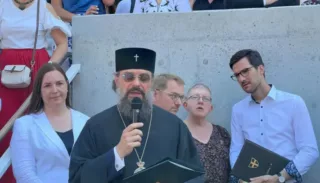
Archbishop Silvester (Stoychev), a hierarch of the Ukrainian Orthodox Church and rector of the Kiev Theological Seminary and Academy, has spoken about the significant complication of the UOC’s relations with the Ukrainian state. According to him, the noticeable deterioration began in the fall of 2022 and reached its peak with the adoption in August 2024 of the law “On Protection of the Constitutional Order in the Sphere of Activities of Religious Organizations,” which establishes a banning procedure for organizations affiliated with the Russian Orthodox Church. The archbishop emphasized that despite conflict situations, including a lawsuit to liquidate the Kiev Metropolitan Church and cases of local pressure, it is more about discrimination than persecution, and called for finding mutual understanding and consensus. He said this in an interview with the Serbian publication VREME.
According to Archbishop Sylvester, during the war years, the UOC’s relations with the state did indeed become much more complicated. “A noticeable deterioration of these relations began in the fall of 2022 and reached its peak with the adoption of the law “On Protection of the Constitutional Order in the Sphere of Activities of Religious Organizations” in August 2024,” he said. The hierarch explained that this law is often misinterpreted by journalists as “the law on banning the UOC”. In fact, it bans the activities of the Russian Orthodox Church in Ukraine, but at the same time establishes a ban procedure for those religious organizations that are affiliated with the ROC, subordinate to it or are a part of it. According to the archbishop, the positions of the state authorities and the UOC are fundamentally at odds on this very issue, as the State Service for Ethno-Politics and Freedom of Conscience insists on the UOC’s connection with the Russian Orthodox Church, which the UOC itself does not agree with.
The hierarch also said that the State Service for Ethnopolitics and Freedom of Conscience has already filed a lawsuit in court to liquidate the Kyiv Metropolitanate of the UOC. Archbishop Sylvester explained that the Kyiv Metropolitanate is a legal and administrative body to which all dioceses of the UOC are subordinated, and its liquidation would significantly complicate the activities of all dioceses, monasteries and spiritual educational institutions, although it would not automatically mean the liquidation of all parishes.
Despite the existence of the conflict, Archbishop Sylvester personally does not consider it possible to speak of persecution of the UOC by the state, distinguishing the current situation from the Soviet period, when the state openly declared its atheistic character and aimed to destroy the Church. The modern Ukrainian state, he said, does not conduct atheistic propaganda and does not prohibit the profession of faith. However, he emphasized that in the current situation of tense relations and the formation of a negative image of the UOC in the public consciousness, which is promoted by certain political forces, it is quite appropriate to talk about discrimination against the UOC.
The archbishop reiterated his conviction that further subordination of the UOC to the Moscow Patriarchate is “simply impossible” and that the Church should seek consensus with the state. In addition to the problems associated with the new law, there are numerous examples of local authorities in different regions of Ukraine participating in the organization of violent seizures of UOC churches and illegal re-registration of parishes, which is a legal arbitrariness. Police inaction during acts of violence against UOC communities has also been noted.
A particularly painful problem is the mobilization of the UOC clergy. The Archbishop reminded that a priest who has taken a canonical oath cannot take up arms and shed blood, which is confirmed by Apostolic Rules 59 and 66, Rule 7 of the Fourth Ecumenical Council and Rule 83 of the Trull Council. At the same time, according to him, today there is no legal mechanism that would protect the right of UOC priests not to bear arms, and this is often used as a means of pressure to force them to transfer to the PCU, whose clerics are not subject to mobilization.
In conclusion, Archbishop Silvester emphasized that despite the many open and difficult issues in the relationship between the Church and the state, it is necessary to seek not confrontation, but ways to mutual understanding, even if communication with government officials is often extremely difficult and tense.
We shall remind you that earlier the Security Service of Ukraine (SBU) officially confirmed that some representatives of the Ukrainian Orthodox Church are being used as an “exchange fund” for the return of Ukrainian citizens from Russian captivity. Since the beginning of the full-scale invasion, the SBU has facilitated the return of 6,266 people, with some of them being released precisely due to the exchange for “odious churchmen”.
Read also