What the rector of KSAIS had to say
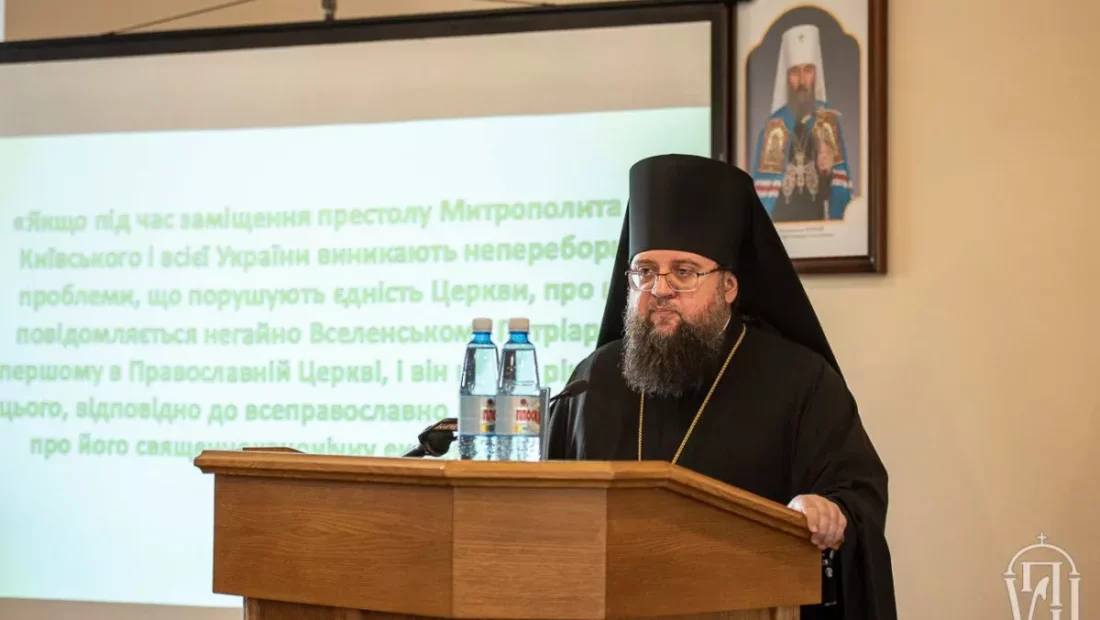
Archbishop Sylvester (Stoichev), rector of the UOC KSAiS, unexpectedly made a complimentary publication about the late head of the UOC-KP Filaret Denisenko. And all would be well, but the bishop considered the fault of the Russian Orthodox Church in the fact that over the long years of the Ukrainian schism, it has not been overcome. Even more importantly, the rector of the KDAiS specified his claim personally to Patriarch Kirill, who, according to Stoichev, almost sabotaged two “perfect chances” to resolve the Ukrainian church crisis. However, first things first…
Unwritten “rules”
“Of course,” writes Archbishop Sylvester, ” many of my readers will immediately ask why I call Filaret Denisenko a patriarch. Of course it will. If Filaret Denisenko is a “patriarch” for Archbishop Sylvester Stoichev, are Mstyslav Skrypnyk, Dmytro Yarema, and Volodymyr Romaniuk the same “patriarchs” for him? Be that as it may, Archbishop Sylvester informs his readers that in “a dialogue between representatives of different church jurisdictions, there is a rule: to use names and titles as they are accepted by each of the parties to the dialogue.” Based on our modest experience, we would like to object to the rector of the KSAiS.
First of all, if there is such a rule somewhere, it definitely does not apply to the relations between the UOC and the UOC-KP and the OCU. First of all, at least because Filaret Denisenko personally called the Ukrainian Orthodox Church the “Moscow Patriarchate” and the “Russian Church” until the end of his days. Accordingly, either Filaret never followed such a “rule” or he did not know about it because, for example, it NEVER EXISTED. There is another option, which Bishop Sylvester is unlikely to agree with. If we still imagine that “patriarch” Filaret followed the “rule” named by the rector of the KSAiS, then it turns out that the Ukrainian Orthodox Church is really a “Moscow Patriarchate” and a “Russian Church,” which, as you know, Archbishop Sylvester has been actively arguing against for the past six months.
In addition, if we develop Archbishop Sylvester’s thesis further, it turns out that both the OCU (the direct successor of the UOC-KP) and the Patriarchate of Constantinople, with which the rector of the KSAiS has recently called for dialogue, do not adhere to this rule either. After all, for the OCU there is no such thing as the UOC at all, and even at the official level, Dumenko refers to the canonical Church as “ROCinU” and the Primate of the UOC as “Metropolitan in Kyiv.” In turn, the Phanar generally “tolerates” the bishops of the UOC, also calling them “bishops of the ROC.” Based on these features of the “interjurisdictional dialogue,” a natural question arises to Bishop Sylvester: why these manners, which are not appreciated by opponents at all and, moreover, are not reciprocated?
At the same time, to solve this dilemma, it is enough to use the language of official documents, which for some reason were not used by the rector of the KSAiS. After 1997, Filaret Denysenko was defrocked and deprived of his monastic dignity by the former Metropolitan of Kyiv, that is, Mykhailo Denysenko. This, by the way, was agreed to by Patriarch Bartholomew, who confirmed this position after a letter from the late Patriarch Alexy II of Moscow and All Russia. The fact that somewhere Filaret is called “patriarch” or using his monastic name is rather a condescension than a church reality.
Non-fictional stories
Next, the rector of the KSAiS decided to convince everyone that the late head of the UOC-KP, starting in the 90s, openly declared his desire to lead the UOC, which he then led, to autocephaly. I don’t want to get into emotional analysis, but it seems that the archbishop’s text is intended for his students who were born no earlier than the 2000s. Older people are well aware of Filaret’s attitude to the autocephaly of the Ukrainian Church before 1992. Similarly, it is impossible to hide the fact that Denisenko’s desire for autocephaly appeared almost immediately after he lost the election for the post of Patriarch of Moscow and was found guilty of serious violations and an authoritarian form of government of the Ukrainian Orthodox Church, which was confirmed by the bishops of the UOC, who did not follow Denisenko after his demarche.
By the way, the Kharkiv Council was a reflection on Filaret’s actions, which the UOC-KP and the OCU consider a “schism” because it was aimed at limiting the usurpation of church power by the future schismatic leader of the UOC. And if the decision of the Kharkiv Council is not an argument for Archbishop Sylvester, who is undoubtedly familiar with this story, then he could ask the current Primate of the UOC what measures Filaret took against the then Metropolitan Onufriy of Chernivtsi, who withdrew his signature from the document “on autocephaly” that Filaret actively “promoted” in the UOC after his fiasco in the election of the Patriarch of Moscow.
“According to numerous eyewitnesses of those events (both those who followed Filaret and those who opposed him), he was a strong, strong-willed personality. But this strength also had a downside: he hardly ever made concessions to his opponents, but tried to force them to come over to his side,” writes the rector of the KSAiS. And who, excuse me, followed him? Yakov Panchuk (died in 2006) and Andriy Horak (died in 2010). In 2006, Oleksandr Stoichev became a lecturer at the Russian Orthodox University (Moscow), and in 2010, Hieromonk Sylvester defended his PhD thesis at the KSAiS. It is unlikely that Sashko in 2006 and Hieromonk Sylvester in 2010 had the opportunity or even the desire to communicate with Panchuk and Horak, two of the dozens of UOC bishops who followed Filaret.
Instead, during his life in the Kyiv Cave Monastery, Stoychev had the opportunity to ask those who did not follow Filaret about those events. And all of them would tell him that Denisenko was a real ghoul who was ready to walk over dead bodies to save his career… figuratively and literally. By the way, the excellent documentary Anatomy of a Schism was filmed in two parts as a “memory pill” about this. There you can hear enough from eyewitnesses of those events, whom Bishop Sylvester calls “Filaret’s opponents,” what they had to go through in those days when Filaret finally “leaked the roof.” Many of them, by the way, are still alive and well, so Archbishop Sylvester could ask them about the events of those days at any time to restore the chronology, as they say.
the “strange story” of 2017
The rector of the KSAiS recalled the “strange story” of a letter in 2017 that the head of the UOC-KP sent to the Bishops’ Council of the Russian Orthodox Church. Back then, there was actually hope that the church split in Ukraine could be overcome. However, it did not work out. Archbishop Sylvester completely undeservedly laid the responsibility for this on the Russian Church and Patriarch Kirill personally. Why undeservedly? Let us try to explain.
First of all, it should be borne in mind that the initiative came from the head of the UOC-KP. Frankly speaking, the Russian Orthodox Church has long since abandoned any hope that the split could be overcome under Denisenko. Every time this was discussed, Filaret set unrealizable conditions, such as the patriarchal status and his supremacy over the united Church. This time, things went completely differently, as the tone of the letter and Denisenko’s mood were diametrically opposed to those he had broadcast before.
It was this sentiment and, according to unverified information, agreements through diplomatic channels that caused the Council to favor the ROC, and the very fact that this issue was considered at all became possible. It is noteworthy that the Russian Orthodox Church even toned down its rhetoric, calling for prayer “for the former Metropolitan of Kyiv.” In other words, the Russian Church took the issue seriously, and their intentions were more than good.
However, everyone remembers perfectly well how these preliminary agreements broke down and who initiated the abandonment of the previously voiced idea, and it was by no means Patriarch Kirill or the Council of the Russian Orthodox Church. it was Filaret himself who “backed down,” rumored to have been pressured by the Poroshenko Administration. At the same time, the head of Phanar became agitated, seeing that the “smell of fried food” was slipping away and the opportunity to use the Ukrainian church crisis as a battering ram against the ROC was slipping away, he urgently decided to create the OCU and “grant autocephaly,” which was supposed to resolve the issue of the split. It was after this that Poroshenko’s team made an active series of visits to Phanar, where they paid a tidy sum for the Tomos.
Who is to blame and what to do
What is the fault of the Russian Church? Even the Council of the Russian Orthodox Church, which took longer than usual, expected that the issue of 2017 would be resolved positively. However, Filaret’s next trick dashed any hopes. Archbishop Sylvester claims that it is the Russian Orthodox Church that is the main opponent of overcoming the split in Ukraine and the independence of the Ukrainian Church. However, in our opinion, this statement is extremely superficial and does not reflect the full picture.
We see the situation as being opposed to a united and independent UOC primarily by the Ukrainian government, which simply cannot allow a powerful independent structure to exist “at its side” that could organize its position against such fundamental issues for the current Ukrainian government as, for example, LGBT issues, religious syncretism, and other anti-Christian messages that are now being actively promoted by Western foundations and organizations operating in the country. It is very interesting why the rector of the KSAiS does not consider the issue in this way.
In this context, it is not surprising that the government has chosen the absolutely loyal OCU as its “servant.” From the very first days of its existence, this structure showed that it would turn a blind eye to all “mistakes,” in fact, taking part in the spiritual corruption of Ukrainian society. But the OCU did not appear by itself. For some reason, Bishop Sylvester is trying to remove from this equation the main denominator – the very Filaret whose “eulogy” the rector of the KSAiS published on his Facebook page.
We will not throw unfounded accusations against Archbishop Sylvester or analyze his psychotype. However, such an “explosive” publication by the rector of the Kyiv Theological Schools indicates some “strange behavior” that has been observed in his recent behavior. Perhaps Archbishop Sylvester believes that the strategy he has chosen will somehow be able to resolve the situation in which the UOC finds itself today, but it is obvious that it will not work that way. It will be much worse if it turns out that the rector of the KSAiS is behaving this way on purpose, trying to become part of someone’s evil plan.