UNESCO Kyiv Mission: Assessment of Hagia Sophia of Kyiv, Kyiv Pechersk Lavra and development in protected areas
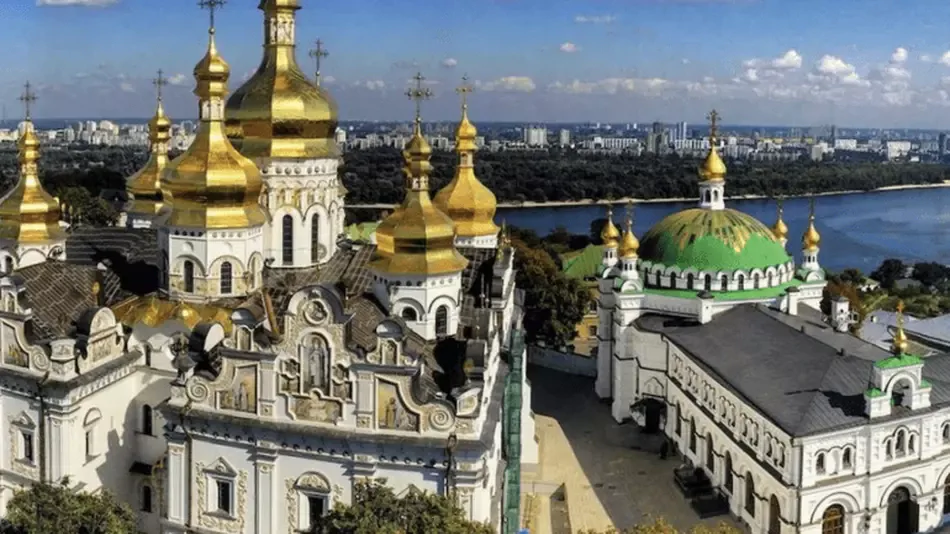
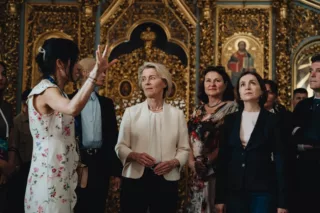
UNESCO’s international experts are in Kyiv on an important mission to assess the condition of the St. Sophia Cathedral and Kyiv Pechersk Lavra, World Heritage sites. The commission not only analyzes the damage caused by shelling, but also scrutinizes the rules of development in the protection zones, as well as the city’s readiness to protect cultural monuments under war conditions. The preservation of the historical image of the capital of Ukraine depends on the decisions of these experts.
According to the Kyiv metropolitan edition , the UNESCO experts’ mission is focused on two key sites that are the city’s hallmarks – St. Sophia of Kyiv and the Kyiv Pechersk Lavra. These monuments are included in the UNESCO World Heritage List, which makes their preservation an issue of not only national but also international importance. The experts do not limit themselves to examining frescoes and walls; they conduct a comprehensive analysis of the entire historical center: how construction and repair work is being carried out, how the city responds to potential risks, and how effectively it protects heritage in war conditions.
As part of their work, the experts, together with the Ministry of Culture and city authorities: assess the state of conservation of St. Sophia Cathedral, monastery buildings and Lavra; prepare an action plan in case of emergencies; check the rules of development in protection zones and analyze the Ukrainian legislation on the protection of cultural heritage.
Special attention was paid to inspecting the buffer zone around St. Sophia, which covers a large part of Old Kyiv, including Volodymyrska Hill, Landscape Alley and Maidan. The commission inspected the objects that have been the subject of many years of disputes among Kyiv residents. Among them are the building at the intersection of Sofiyivska and Volodymyrska Streets, recently recognized as a newly identified monument, the house on Gonchar 17/23, where it is proposed to dismantle the superstructured floors, as well as the restoration of the “house with snakes and chestnuts” on Bolshaya Zhytomyrska and part of Landscape Alley.
In essence, the international experts are called upon to resolve a dilemma that has been discussed in Kyiv for two decades: where the boundary between the development of the city and the destruction of its historic environment lies. The mission was initiated by the UNESCO World Heritage Committee after the damage caused to St. Sophia Cathedral in June 2025 and the buildings of the Kiev-Pechersk Lavra, including the entrance to the Far Caves and the Anno-Zachatievskaya Church, in January 2026 as a result of Russian shelling. The experts’ task is not only to assess the damage, but also to identify common risks, from blast waves to chaotic development.
In the context of new approaches to heritage protection, Sofia Kievskaya has presented projects to create 3D models of monuments, digital archives and emergency response scenarios, effectively a transition to a format of “digital doubles” of historical sites for worst-case scenarios. Sofia’s buffer zone is not just an abstract concept from UNESCO documents; it is a living space where the life of the city is lived on a daily basis. If the experts recognize that the monuments are under threat, there will be real consequences: from bans on new development in the center to international control over any reconstruction.
Thus, at stake is not only the fate of the ancient walls, but also the identity of Kiev itself: whether it will remain the historical center of Europe or will turn into an ordinary metropolis, the memories of the past of which will be stored only in archival photographs.
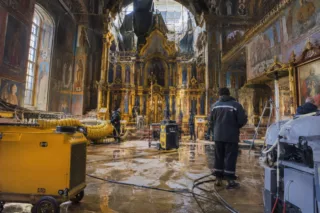
Earlier it became known that in the storerooms of the National Reserve “Kyiv-Pechersk Lavra” there was a serious accident – a break in the heating system, resulting in a threat to about 4000 valuable museum exhibits. The incident led to the flooding of the rooms where the collections “Negatives”, “Graphics” and “Paintings” are kept.
Read also