OCU, Ukraine and Georgia: Will the Georgian Church abandon the idea of recognizing the Ukrainian schism?
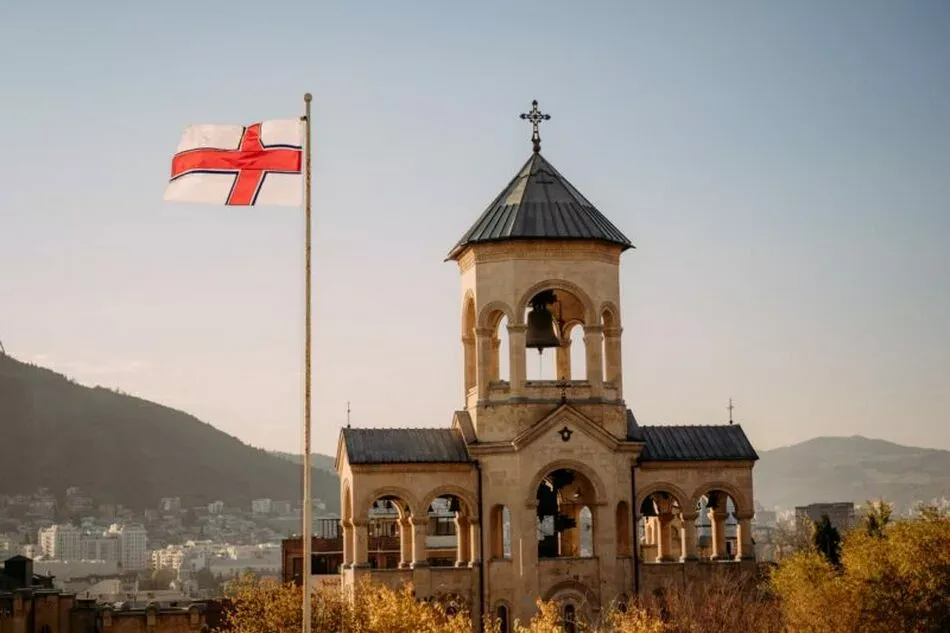
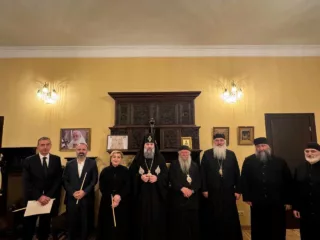
The club of promising “friends” of the OCU seems to have shrunk again. Until recently, the Georgian Orthodox Church was a risk group in terms of its attitude to the Ukrainian church crisis, as it has never spoken out on the topic since the creation of the OCU. However, the political events currently taking place in Georgia and the reaction of the Ukrainian side to them may change the position of the GOC.
It is not difficult to understand what is happening in Georgia. Most analysts draw an obvious parallel with the events in Ukraine in 2014, when the so-called Revolution of Dignity, supported by the United States and the EU, overthrew the current government, which resulted in the loss of political subjectivity, war, the loss of part of Ukrainian territory, and, most importantly, the deaths of hundreds of thousands of Ukrainians. Georgia is being rocked by the same scenario, and, notably, for the second time in the last twenty years.
However, the situation in Georgia is still different from what happened in Ukraine, as the religious factor is minimally involved in the process. Unlike Ukraine, Georgia does not have such a wide range of religious organizations, and Georgians are mostly believers of the Georgian Orthodox Church, which has no alternatives in the country. This allows the GOC itself to pursue a policy of pacifying society, unlike, for example, the former UOC-KP and the UGCC, whose representatives in 2014 on the Maidan were openly inciting hatred and enmity toward dissenting and nonreligious Ukrainians.
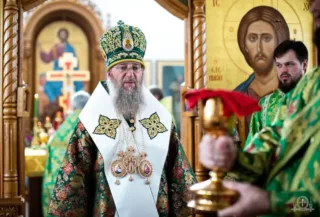
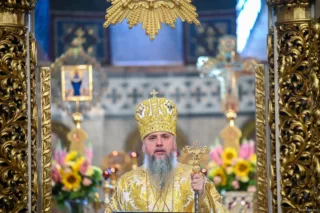
Thus, at this stage, the Georgian Church, although restrained, still calls on the participants of the anti-government protest to peace and mutual respect, which, of course, contrasts with the “gapon priests” from the OCU, who, as in 2014, so often now, call people “to the barricades.” However, what happened this time should force the Georgian authorities and the Georgian Church to reconsider their attitude to the phenomenon of the Ukrainian church schism, because while the official GOC calls for peace, Epiphany Dumenko expresses support for the anti-government protest in Georgia.
Think about it! The head of a Ukrainian religious organization supports an anti-government protest in a FOREIGN COUNTRY! It is noteworthy that this is happening almost simultaneously with the imposition of sanctions by Vladimir Zelensky against key politicians of the ruling party of Georgia. Let someone then say that the OCU is not a “state church.” Can anyone remember at least one Local Church that spoke out for or against the events in Ukraine in 2014?
Although the fact of Dumenko’s interference in political processes in a foreign country and, in fact, incitement to anti-government protests in Georgia has gone unnoticed, I want to believe that when passions subside in Sakartvelo, someone will prompt the government of this state to take appropriate measures in response to the head of the OCU. It seems that personal sanctions and a lifetime ban on entry to Georgia will be enough. We also hope that the Georgian Church will finally take a firm and clear position on the Ukrainian church crisis and, following the example of the majority of Local Churches, will express support for the Ukrainian Orthodox Church and abandon the policy of uncertainty in this matter.
Read also