Fault lines in the OCU
Based on our previous publication, our readers are rightly asking themselves why we believe that the OCU may disappear from the religious map of Ukraine in the event of a peaceful settlement of the Russian-Ukrainian war. The question is not an idle one, because now the OCU looks relatively monolithic. But we have the impression that this Colossus is on feet of clay.
First of all, we need to understand that at this historical stage, the OCU is entirely dependent on the policy of the country’s leadership. It is becoming increasingly difficult to conceal the church-state symphony that has taken place in Ukraine, because the OCU is already quite openly supported by the government: this includes the transfer of religious objects and the organization of events in Ukraine and abroad.
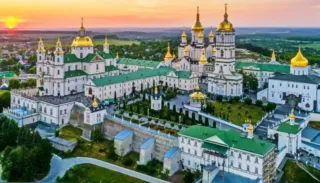
In return, the OCU pays with complete loyalty, ignoring the openly anti-Christian course that is being taken as a basis in Ukraine. A striking example is the situation with the Kyiv-Pechersk Lavra and other churches taken away from the UOC, where anything but what should be is happening. Has anyone heard about the concern of OCU officials, say, about the fact that several churches in Chernihiv were closed, turning them into museums and the relics of saints into exhibits? We have not heard about it either.
At the same time, Epiphany Dumenko speaks at political events, calling for the return of nuclear weapons to Ukraine, arming the country “to the teeth,” apparently so that Ukrainians will fight for decades, and as a result, cease to exist purely physically. What does he care? He will not go to war. Neither will the clergy of the OCU, 70% of whom are registered “chaplains” who do not leave peaceful territories and are engaged in outright robbery of UOC parishes. They get away with it for one reason only — the state still needs the OCU.
As for the internal situation, this is where the most interesting things begin for the OCU. Recently, even though it has full access to administrative resources, it has become increasingly difficult for the OCU leadership to contain internal contradictions, which will soon become louder and more pronounced under the influence of external circumstances.
Rift #1: UAOC in the OCU
Conflicts between former representatives of the UOC-KP and the UAOC within the OCU have become commonplace. In fact, they took place even before the unification, because the Kyiv Patriarchate, at the suggestion of Filaret Denisenko, was firmly convinced that the UAOC was a schismatic group. Even after the unification of the two branches of the Ukrainian schism, the situation did not improve. Former members of the UOC-KP appropriated the parishes of the UAOC, leaving the UAOC hierarchs virtually destitute. This situation later resulted in a series of conflicts between the former and the latter. There are cases when the UOC-KP actually seized the parishes of the UAOC, already being a single structure.
Such representatives of the UAOC as Gabriel Kryzyna, Volodymyr
Shlapak, and Afanasiy Shkurupiy. They accuse their “brothers in the shop” of seizing parishes that were previously part of the UAOC, and under the OCU came under the control of the hierarchs of the former UOC-KP.
In addition, there are disputes over a number of fundamental issues, such as the calendar. The demarche of Afanasy Shkurupiy, who categorically refuses to switch to the “new style” despite the fact that the New Julian calendar is officially adopted by the OCU, is widely known.
Rift #2: OCU and Zinkevich
Only the lazy have not talked about the conflict between the head of the OCU Epiphany Dumenko and the head of the Volyn Diocese of the OCU Mikhail Zinkevich. The latest public humiliation of Zinkevich by the Synod of the OCU only confirms our arguments that we have made on this topic before. Dumenko will do everything possible to “sink” his direct competitor, which is why Zinkevich has not yet taken open steps to confront him.
Naturally, Epifaniy’s Volyn rival understands that as long as Dumenko is in the government, he will not be able to realize a successful coup in the OCU. However, as the political situation changes and the state’s interest in supporting the OCU wanes, this conflict will inevitably come to light.
Be that as it may, Zinkevich has taken a wait-and-see attitude, and the OCU Synod’s attacks on him actually show the weakness of Dumenko himself, who decided to deal with his rival with other people’s hands.
Rift #3: OCU and ex-UOC
The ex-hierarchs of the Ukrainian Orthodox Church, Simeon Shostatsky and Alexander Drabinko, who joined the OCU in 2019, are also, to put it mildly, dissatisfied with the situation in the “unified church.” They were joined by priests who left the UOC for the OCU and created the Sophia Brotherhood. Both the former and the latter cause outright irritation among the leadership of the OCU, since, although they have said goodbye to the UOC de jure, they de facto remain committed to their former colleagues. In addition, when they found themselves in the OCU, instead of the “open church” announced by Epifaniy, they saw an authoritarian model of government.
Epifaniy’s one-man rule, the lack of recognition of the structure by the Local Churches, as well as the aggressive policy of the OCU towards the UOC, force defectors to look for a third way, which makes the key functionaries of the OCU very angry. Such an alternative is considered to be the creation by the Patriarchate of Constantinople of an additional exarchate, which could include all those who are dissatisfied with the internal vicissitudes and showdowns. With the hope of such a scenario, this group of clergy actually joined the Phanar’s exarch in Ukraine, Bishop Mikhail Anishchenko of Komana.
It is noteworthy that not so long ago, information leaked from the Patriarchate of Constantinople that there was a conflict between the head of the OCU and the exarch, which even resulted in mutual complaints sent to the Phanar Synod. In this regard, the Phanar even started talking about replacing Dumenko, but apparently this issue was postponed “until better times.”
Which scenario will work?
Before discussing this topic, it is necessary to start from political realities. In recent months, the OCU has suffered a number of serious blows. These include the restriction of Western funding and the loss of lobbyists in Washington, D.C., which occurred in connection with the election of a new US president. A serious image blow was dealt to the OCU by the new White House LOMs. Bob Amsterdam’s interview with Tucker Carlson, in which the OCU was called a “fake church,” is an extremely unpleasant signal for the OCU.
In addition, the issue of criticism of the OCU leadership in Phanar has not been fully resolved. Earlier, we published an insight that Istanbul is seriously considering reconsidering its attitude toward the OCU in connection with a number of church scandals in Ukraine. The Phanar does not want to be responsible for situations like those that the whole world saw in Cherkasy when the UOC Cathedral was seized.
The OCU now resembles a locomotive without brakes. The intensification of the raider attack on the Chernivtsi Diocese of the UOC, which may well lead to what happened in Cherkasy, is another disadvantage of the OCU itself, which has failed to realize itself as a “single church.” In addition, such actions cast a shadow on Patriarch Bartholomew, who, by the way, has recently limited his contacts with the head of the OCU.
Given the above fault lines, it is impossible to say that one of them will work. Most likely, the situation in the OCU will change for the worse due to the combined impact of these aspects.
Read also