The Ecumenical Patriarchate’s Exarch in Ukraine Believes the OCU Is Ready for Self-Criticism Within Its Ranks
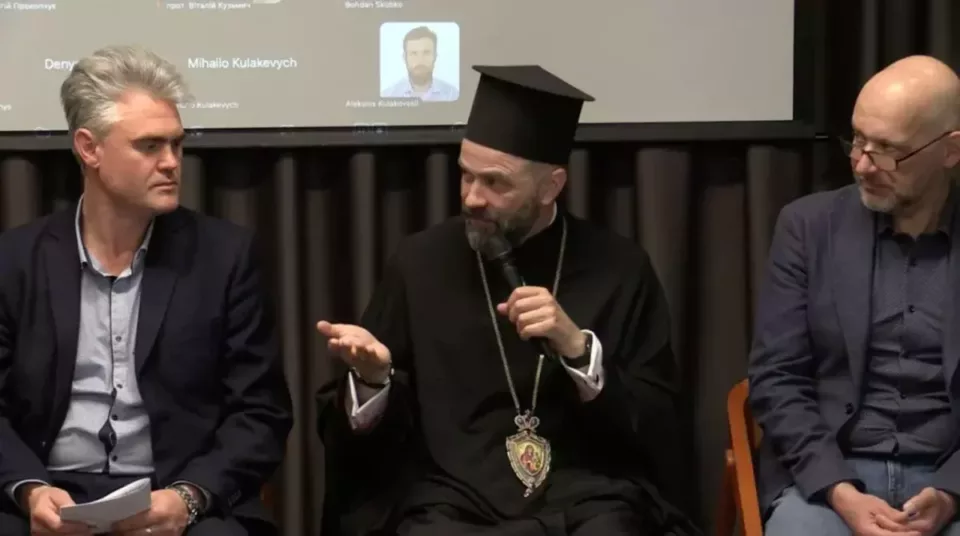
On April 29, 2025, a round table titled “Contemporary Ukrainian Orthodoxy: Breaking Myths for the Sake of Reconciliation Among Orthodox in Ukraine” was held in Kyiv. The event was organized by the St. Sophia Brotherhood with the support of the German foundation Renovabis. One of the central addresses was delivered by the Ecumenical Patriarchate’s Exarch in Ukraine, Bishop Mykhailo Anishchenko, who stated that there is a growing readiness for internal criticism within the Orthodox Church of Ukraine (OCU). This was reported by the website of the St. Sophia Brotherhood.
“I have noticed a very encouraging trend. People have begun not only to reflect, but to admit that not everything may be well. And when such self-criticism appears, it means we recognize the problem and are looking for ways to solve it,” the Exarch stated.
Anishchenko criticized the idealized rhetoric often heard at OCU forums:
“When we hear how everything is great, parishes are growing, donations are increasing — we realize we are living in a utopia or simply refusing to face reality.”
According to him, true “spiritual recovery” is only possible when not only hierarchs, but also regular clergy and laypeople are involved in the Church’s internal discourse.
“As was rightly said, those who live in their bubbles must be brought back down to earth. But that won’t happen without the laity. We should not be afraid of analysis — not with anger or the desire to humiliate anyone, but with the goal of highlighting problems as they really are,” Anishchenko believes.
In conclusion, the representative of Constantinople said:
“Often, the Church’s position is perceived as the opinion of certain high-ranking church officials. But that’s not how it should be! When the Body of Christ begins to reflect in its fullness, laypeople also have the right to express their opinions — even to disagree. Of course, this disagreement should be expressed respectfully and with reasoning. That’s the purpose of assemblies, councils, and so on. This is the restoration of conciliarity — to listen to one another and to reduce the level of authoritarianism that, unfortunately, has penetrated relationships within the Church. This opens a broad field for discussion, both theological and in terms of inter-church relations. So today I rejoice to observe this trend: the emergence of sound thinking, an honest view of ourselves and our problems, and the absence of fear to acknowledge them — both before others and before ourselves.”
It is also worth noting that on January 7, 2025, the Ecumenical Patriarchate’s Exarch in Ukraine, Bishop Mykhailo Anishchenko of Komana, led the Christmas celebrations according to the Julian calendar. Anishchenko emphasized that the choice of calendar is secondary — what truly matters is the way in which the feast is celebrated.
Read also