Hierarch of the Phanar: The separation of the Eastern and Oriental Churches is not theological, unity is possible
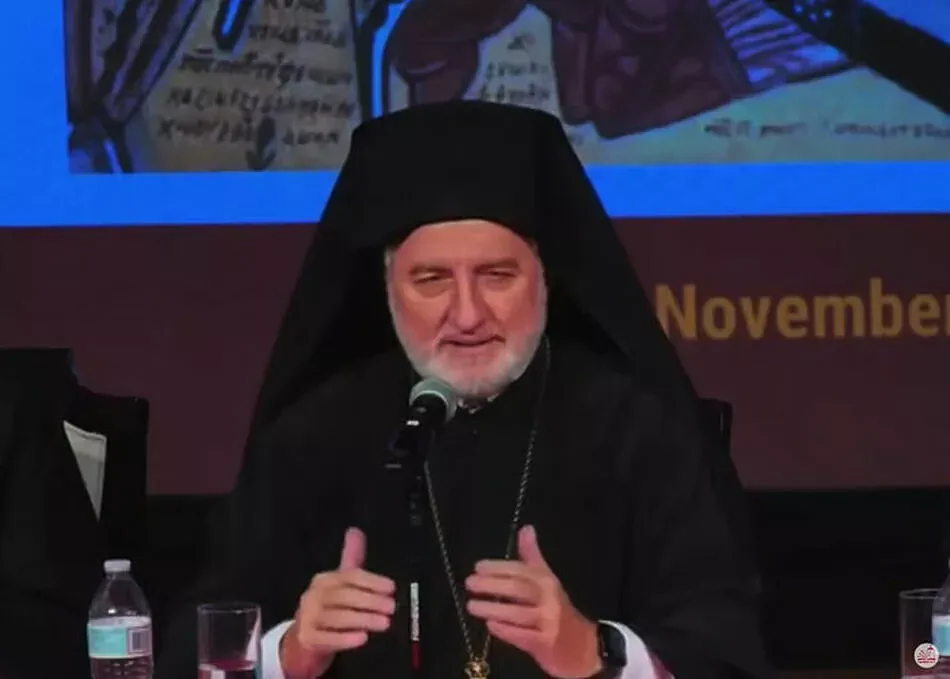
Archbishop Elpidophoros of America (Greek Orthodox Archdiocese of America, Patriarchate of Constantinople) stated that the division between the Oriental and Oriental (Dochalcedonian Churches, – ed.) Orthodox Churches is not inherently theological. He emphasized that despite the theological agreements reached decades ago, unity has not yet been restored due to non-theological reasons. In his remarks, the hierarch also sharply criticized the contemporary breaks in communion caused by jurisdictional disputes.
Speaking Nov. 4-6 at the Huffington Ecumenical Institute’s conference “Eastern and Oriental Orthodox Churches: Advancing Dialogue” in Brookline, Massachusetts, Archbishop Elpidophoros challenged what he called “theological romanticism” regarding church divisions. “We always romantically think that all the reasons for our divisions are theological. This is theological romanticism, ecclesiastical romanticism, which has little to do with reality, the historical reality of the true reasons why we don’t have communion,” he said. He cited historical events after the Fourth Ecumenical Council in Chalcedon as confirmation of his words, noting that “for at least 200 years after the Fourth Ecumenical Council we had communion” despite the Christological disagreements. According to the archbishop, the division was ultimately caused by political rather than theological factors, such as the “Arab invasions” and the persecution by Byzantine emperors of Christians who did not accept Chalcedon.
As Archbishop Elpidophoros noted, the theological dialog between the Eastern Orthodox and Oriental Churches “was completed decades ago.” He referred to the Joint Commission on Theological Dialogue between the Eastern Orthodox Church and the Oriental Orthodox Church, which met several times between 1964 and 1993, producing agreed statements in 1989 and 1990. The latter states, “We have now clearly realized that both families have always faithfully maintained the same authentic Orthodox Christological faith and the unbroken continuity of the apostolic tradition, although they have used Christological terms in different ways.”
Despite this agreement, the archbishop described the ensuing impasse: “We agreed on theology. On everything. There is an agreement. It was made decades ago. And then we realized, ‘OK, now what?’ The bishops were stumped because they saw that theologians had agreed.” He added that the bishops “are not ready for other reasons this time, not for theological reasons. They are not ready for communion, for unity. This means that we are dishonest when we say that the real reasons why we are not united and we don’t have communion are theological reasons.” Moreover, in his view, even clergy often fail to understand the theological differences. “If we survey not the laity, but the clergy of both traditions, Oriental and Eastern, and ask them what is the difference between the two Churches – the theological, Christological difference – the clergy, not the laity, don’t have the slightest idea. This is the reality.”
The archbishop also criticized how easily modern Orthodox Churches break communion over jurisdictional disputes. He cited the recent rupture between the Patriarchates of Jerusalem and Antioch over jurisdiction over Qatar, as well as the Moscow Patriarchate’s break in communion with those who accepted Constantinople’s Tomos of autocephaly granted to the “Orthodox Church of Ukraine.” Other recent examples included the breakdown of communion between Patriarch Bartholomew and the Holy Synod of Constantinople with Archbishop Christodoulos of Athens in 2004 over the issue of jurisdiction over several dioceses in northern Greece.
Archbishop Elpidophoros concluded with a harsh assessment, “Let’s be honest, if we believe that theological agreement is sufficient to move toward communion, the other possibility is hypocrisy. We are dishonest when we dialog.”
Recall that earlier we reported that the Primate of the Russian Orthodox Church, His Holiness Patriarch Kirill of Moscow and All Russia , held a meeting with the delegation of the Coptic Church, which arrived in Moscow to participate in the Commission for Dialogue between the Russian Orthodox Church and the Coptic Church. During the meeting, in particular, the ban on the Ukrainian Orthodox Church was discussed.
Read also