In 2018, Phanar "turned a blind eye" to invalid ordinations of some OCU hierarchs

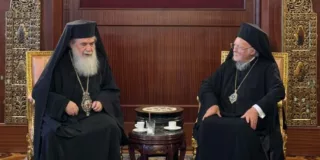
The Phanar (Patriarchate of Constantinople) explained the decision to recognize the first episcopal ordinations of the so-called Ukrainian Autocephalous Orthodox Church (UAOC) as valid, despite the participation of the impostor Vikenty Chekalin. Historian and religious scholar Serhiy Shumylo studied the issue in detail and presented a report to Patriarch Bartholomew.
According to his research, Vikentiy Chekalin, born Viktor Chekalin, was an impostor who was not a bishop. In 1986, in the USSR, he was accused of lewd acts against schoolchildren, arrested, and a forensic medical examination declared him mentally ill. After his early release in 1987, in 1989 Chekalin unexpectedly found himself in New York in the synod of the non-canonical Russian Church Abroad, where he began to impersonate a bishop of the schismatic Catacomb Church. Already in early 1990, at a meeting of the synod, it was proved that Chekalin was not a bishop, and he could not confirm the fact of his ordination with any documents.
Nevertheless, according to Shumylo, in March-April 1990 in Lviv, Chekalin, together with Archbishop John Bondarchuk, who had been defrocked in 1989, took part in the first two episcopal ordinations for the UAOC. on March 31, 1990, they «ordained» Vasyl Bondarchuk, John’s brother, and on April 5, Andriy Abramchuk, now the «Metropolitan of Ivano-Frankivsk» in the OCU. According to Shumylo, these two ordinations began the history of the revival of the UAOC hierarchy.
In 2018, Serhiy Shumylo sent Patriarch Bartholomew a letter-report on Chekalin’s imposture, prepared with the blessing of one of the most authoritative Orthodox theologians of the twentieth century, Metropolitan Callistus Vera of Diokleia. The report was followed by many hours of discussions with the Secretary General of the Holy Synod of Phanar. As a result of reviewing all the materials, Phanar recognized that Chekalin was indeed an impostor and his episcopacy could not be recognized.
However, the Phanar stated that John Bondarchuk, although defrocked in the Russian Orthodox Church, at the time of his ordination «was a legitimate bishop of the Moscow Patriarchate, who had undisputed apostolic succession, and there are no questions about his succession.» Thus, Constantinople decided to consider these ordinations as solemn, performed by a legitimate bishop (Bondarchuk). The secretary of the Phanar Synod explained the position of the Patriarchate of Constantinople, comparing Chekalin to zero:«Chekalin is a zero, that is, he is not a bishop at all, he is a random person who was there due to certain circumstances. He is a zero. And in mathematics, whether you multiply by zero, divide by zero, add zero, subtract zero, he does not create anything, does not give anything as a result.» The presence of Chekalin’s «zero» did not affect the validity of the ordination, which was led by a legitimate bishop.
According to Shumil, in this case, Phanar applied the principle of oikonomia. He explained the position of the Church of Constantinople:«Any schismatic community is a priori non-canonical and is outside the Church until it reunites with the Church. At the moment, that is, until it joins the fullness of the Ecumenical Church, any schismatic community is considered to be separated from the Church, graceless in essence. And it is filled with grace at the moment of accession, initiation into the Church, inoculation. And there are different forms of such inoculation. One of the forms is through acceptance into the concelebration.»
Earlier, the rector of the Kyiv Theological Seminary and Academy, Archbishop Sylvester (Stoichev) , commented on the validity of the priestly ordinations of the OCU representatives. The hierarch argues that the ordination of a significant part of the OCU ministers cannot be recognized due to canonical differences and the canonical practice of the Church. In addition, the bishop is convinced that the existence of the Tomos of autocephaly of the OCU can in no way be a reason to change the attitude to this issue.
Read also