How the UOC became the “golden calf” of the Ukrainian authorities
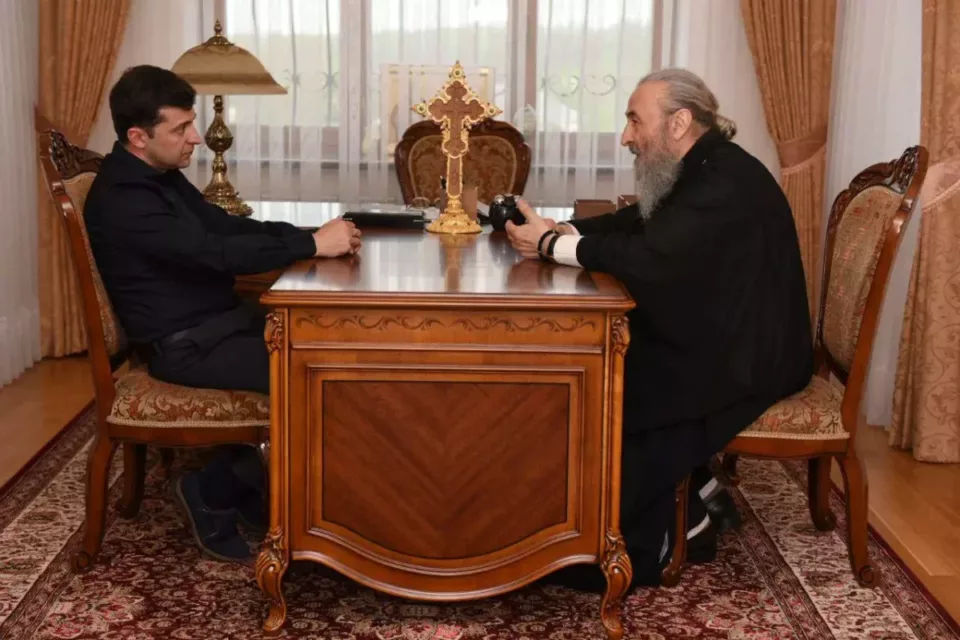
As we have repeatedly written, it would be absolutely wrong to consider the case of the UOC ban outside the general political context. Yesterday, MPs staged another round in the fight against “Moscow priests,” which looked more like an imitation of an attempt than actions aimed at banning the Church.
Please note that the “saga of the ban of the UOC” has been going on for years and for some reason cannot come to an end. In the Rada, the bill is either postponed or finalized. It is either lost in the office or not brought to the session hall. Is there really a lack of votes in the Parliament? I doubt it. Unrelated MPs have repeatedly stated that they have the potential. However, the draft law is stubbornly not getting through the doors of the Verkhovna Rada. Let’s try to figure out what the reason is.
Have the MPs become believers?
We have nothing against believing MPs, and we have no doubt that there are some in the Rada. However, faith in dollars and other “goodies” in the Ukrainian parliament is a much more popular religious belief than sincere concern for the fate of the UOC. This has been repeatedly confirmed by the fact that MPs elected in constituencies with a traditionally Orthodox population (parishioners of the UOC) often remained silent when it came to repressions against the Church. Moreover, some of them gave votes for Bill 8371 when it was considered in the first reading, and later signed up to vote in the second.
Therefore, it is extremely doubtful that the bill to ban the UOC does not pass to the Parliament because of Orthodox MPs. Moreover, for reasons of conscience, these MPs could, for example, not support other anti-popular laws that they voted for earlier (postponement of church holidays, ratification of the Istanbul Convention, tariff increases, the law on transfer pricing, bribery, etc.).
It is also noteworthy that it is the “servants” who are reluctant to vote for the ban on the UOC, who were previously ready to support anything, especially if the initiative came from the Presidential Office. We recall cases when, for example, MPs from the Servant of the People who did not want to vote in sync were simply expelled from the faction. And here, such a fundamental law! Poturayev runs around the Rada like a madman and brands those who disagree with the ban on the UOC as a “cotton swamp,” but no party sanctions are applied to them!
This whole situation indicates that the Presidential Office simply does not have a command to vote for the ban on the UOC. Naturally, the “servants” will play along with both supporters and opponents of the adoption of Law No. 8371. It is vital for them to remain “their own” for all parties to the conflict, so the Servant of the People party has conditional “Poturayevs” and “Buzhans” who are a counterweight to each other, creating a party balance. But behind these scales is the head of the faction, David Arakhamia, who “manually” regulates the “flame” so that “the milk does not run away.”
Poroshenko as a battering ram of the UOC
Naturally, in order to create an additional front in the church issue, villains are also needed to take on all the negativity. Petro Poroshenko with his “European Solidarity” perfectly fit this role. The position of the “gray-haired hetman” and his wards is absolutely unprincipled, sometimes even extremely radical. And, on the one hand, this is not surprising, because it was Poroshenko who “made a mess” with the Tomos during his presidency. The ex-president, who swears “f*ck the Orthodox,” looks very organic in the image of the new Nero.
But it is worth paying attention to a few points. First, it was the church case that “buried” Petro Poroshenko’s presidential campaign. His Tomos tour annoyed Orthodox Ukrainians so much that they were ready to vote for a stool as president. However, since the stool did not run, they had to vote for Zelensky.
Second, the OCU has repeatedly “disowned” Poroshenko as its patron. Epifaniy has repeatedly stated that his organization is a self-sufficient structure that does not need the patronage of the former president. At the same time, Dumenko has often professed his sympathy for the “gray-haired man’s” direct competitor, Volodymyr Zelenskyy, demonstrating his political superiority.
Third, Poroshenko himself is not particularly picky about his religious preferences. The ex-president participates in the religious events of the OCU along with the UGCC, not considering it something indecent, while the two denominations have frankly cool relations. It is an open question how long the OCU will ignore the “communion” of Poroshenko and his family in UGCC churches. It should be borne in mind that the UGCC itself does not approve of the OCU, even severely punishing its clergy for joint performances with the functionaries of the Ukrainian schism.
The fact that the President’s Office is keeping Petro Poroshenko in a “hedgehog’s mitts” remains undeservedly overlooked. At any time, Zelensky and Yermak can initiate a criminal case on high treason, which is hanging over Poroshenko like a sword of Domoklov. If this happens, Petro Oleksiyovych’s political career will be over, and he will go to jail. And something suggests that this factor is the determining factor in the activity of the “hetman” and his “Eurosolidarity” in the issue of banning the UOC.
Working as an “opposition” but not actually being one is the way Poroshenko’s political activity, which is 80% populist, is carried out. The activity of the ex-president in the issue of banning the UOC actually takes the negative of this case away from Zelensky and Yermak, and the anti-church activities of European Solidarity cover other anti-people legislative initiatives of the “mono-majority”, which, by the way, Poroshenko’s supporters actively vote for at parliamentary sessions.
If Poroshenko had the opportunity to become a real opposition to the current government, the church issue would hardly be even tenth in his political struggle. After all, there is corruption in the army, “special flights” during the coronavirus, and many other topics that, if properly and constantly presented, could significantly spoil the political rating of opponents. However, apparently due to the threat of criminal prosecution, Poroshenko has only the fate of the “UOC battering ram” to keep this topic afloat and the Church itself in suspense. And the most important thing is that this is happening in absolute symbiosis with the President’s Office, which is the ultimate stakeholder in this case.
The UOC is part of a bigger deal
The government’s struggle with the Ukrainian Orthodox Church resembles the pulling of a bowstring — it is weakened and then strengthened. However, it must be remembered that the archer’s task is to hit the target, and not just shoot anywhere, because one day you can shoot yourself in the head. Therefore, the persecution of the UOC has a wave-like character.
While, for example, the All-Ukrainian Council of Churches supports the adoption of Law No. 8371 in any version, the State Service of Ukraine for Ethnic Policy and Freedom of Conscience is doing everything to prevent the bill from reaching the stage of voting in the second reading. The DESS has even engaged its own in-house experts, who, although they called for the ban of the UOC a year earlier, now publish diametrically opposed opinions on this issue.
It should be borne in mind that both the AUCCRO and the SSERF are, as they say, “flesh and blood” structures and, in theory, they could not contradict each other. However, for example, Dumenko simply “jumps out of his cassock” and demands that the UOC be banned, while a certain religious expert Filipovych suddenly declares that the Church should not be banned at all.
All these inconsistencies indicate only one thing: the Presidential Office has completely different plans for the conflict between the state and the Church. The UOC was made part of a big deal because they realize that even if the decisions of the Council in Feofaniya are taken into account, the canonical Church in Ukraine remains part of the sphere of interests of the Russian Orthodox Church, and thus of political Russia.
It is no coincidence that recently there have been statements that the bishops and clergy of the UOC should be exchanged for Ukrainian prisoners of war more often. This narrative is increasingly heard in the media, and, to our great sorrow, the Ukrainian Orthodox Church itself has become the subject of an exchange fund that is used in one way or another to achieve some political goals.
One way or another, peace talks between Ukraine and Russia are being heard more and more often. This means that the relative peace of the UOC in Ukraine will sooner or later be exchanged for something interesting, such as the right to continue the transit of Russian oil and gas to Europe through the country or, perhaps, a part of the occupied territories that are not part of the final sphere of influence of the Russian Federation.
Even more importantly, this card can be played both in the case of failure to pass Law No. 8371 and if the law is passed. Even the successful passage of the second reading in the Rada does not guarantee the final adoption of the law, as it may be vetoed by Zelenskyy himself, who will then be called “Volodymyr the Merciful” or “Volodymyr the Pious.”
Such a scenario is even more likely given the fact that the Ukrainian church crisis has unexpectedly become the subject of an election campaign in the United States. Given that Republican candidate Donald Trump is likely to become the next president of the United States, Zelensky, by “pardoning” the UOC, will be able to show his commitment to traditional democratic values, earning additional favor with his overseas masters.
This is even more convenient because in the case of the upcoming election of a new president of Ukraine, Zelenskyy, having preserved the UOC, will be able to beat Poroshenko in the election race, showing himself to be a greater democrat than his counterpart. In addition, adherence to Republican values is also an additional reason to remain on U.S. subsidies, without being burdened with thoughts of how to form the state budget on its own.
Thus, by banning the UOC or allowing it to exist, the Office of the President of Ukraine will remain in an attractive light in the eyes of both Russians and Americans. The UOC is the “golden calf” of the Ukrainian political establishment, from which you can pinch off a piece or tear off a whole leg without any risks. Even better, this resource has already been formed and consists of Ukrainian citizens who are not particularly reactionary in terms of protest and will certainly not leave this “submarine.”
Read also