How the OCU violates its own Tomos and invades the borders of other Local Churches
The OCU’s attempts to establish relations with other Local Churches have frankly stalled. Either the completely spoiled image of the OCU or canonical obstacles have finally sobered up the representatives of world Orthodoxy, and now the Local Churches do not even express cautious thoughts about the possible establishment of relations with the Ukrainian schism.
However, the OCU itself did not worry about this and decided to simply step over the heads of the Orthodox Patriarchs, invading their canonical boundaries and even establishing parishes at the side of a number of Local Churches. This time, we are talking about violating the borders of the Jerusalem Patriarchate and the Polish Autocephalous Orthodox Church.
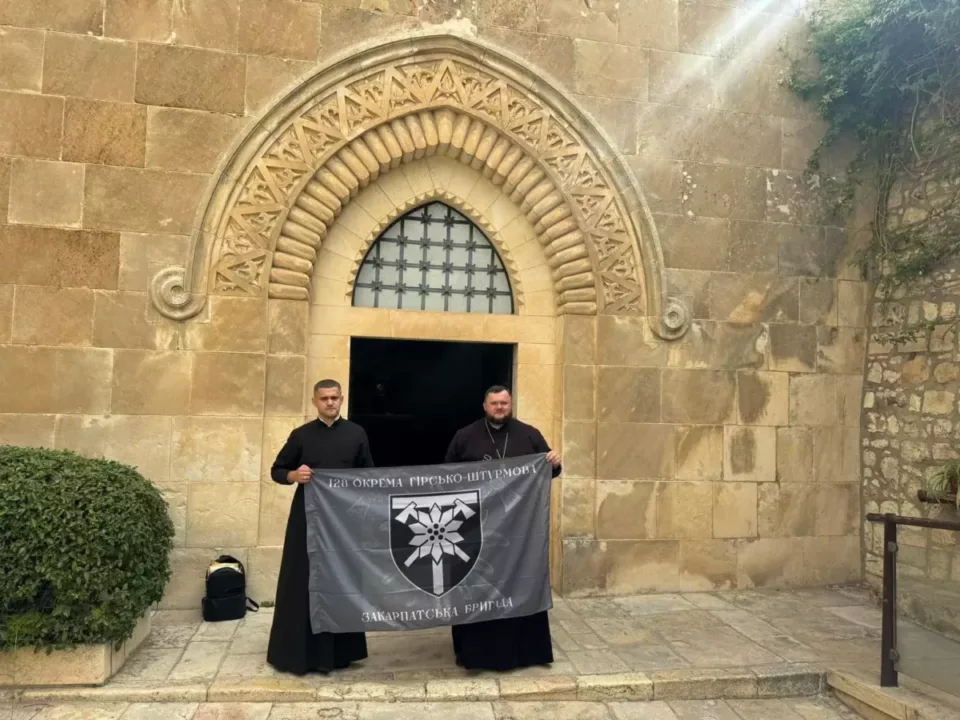
On October 3, 2024, the head of one of the dioceses of the OCU in Transcarpathia, Varsonofiy Rudnik , wrote the following on Facebook: “In one of the oldest churches located along the Cenacle and the Holy Sepulcher in Jerusalem, together with believers and priests of the Rivne, Lviv and Transcarpathian dioceses of the OCU, we celebrated the Divine Liturgy.” He accompanied his comment with a photo report. What does this mean in the language of the Local Churches? The OCU, without prior sanctions from the Jerusalem Patriarchate, holds religious events within this Orthodox Church. From the point of view of interchurch relations (and the OCU claims to establish such relations), such a step is extremely unfriendly and certainly does not contribute to the establishment of a dialogue between the OCU and the Jerusalem Patriarchate.
It is worth noting that representatives of the OCU behaved in this way even before the Tomos of autocephaly was granted to them, that is, before they were recognized by Phanar and its Greek satellites. They were simply looking for churches of Catholics or local schismatics to demonstrate their invulnerability from there. Naturally, such behavior – given the calculation to establish the structure’s subjectivity – is unlikely to be positively assessed in Phanar, let alone in Jerusalem.
However, no episodic appearances are worth anything compared to the full-scale deployment of the OCU’s activities in foreign canonical territories. It should be reminded that according to one of the provisions of the Tomos of autocephaly of the OCU, the organization has no right to establish communities outside Ukraine. All previously established parishes of the UOC-KP and the UAOC abroad were supposed to become part of the Patriarchate of Constantinople. In reality, things are a little different.
Former parishes of the UOC-KP and UAOC abroad are in no particular hurry to join the Phanar, announcing demarches and even creating new jurisdictions from time to time. Moreover, the OCU itself is still creating parishes abroad, calling them “chaplaincy missions,” the existence of which, by the way, has not been approved by any Synod of the organization and has no logical, legal, and even more so canonical basis. For example, several such cases have occurred in neighboring Poland.
Whether the Polish Church knows about it or not, there are 9 parishes of the OCU in Poland within the framework of the “Chaplaincy Mission of the OCU in Poland.” We are talking about Warsaw, Wroclaw, Poznan, Katowice, Lublin, Krakow, Kielce, Lodz, and Gdansk. Thus, the PAOC, which did not recognize the OCU, is the only Local Church affected by the invasion of Ukrainian schismatics. For example, there are no UOC parishes in Poland, as the Eucharistic communion between the UOC and the OCU is maintained, and Orthodox Ukrainians in Poland are safely worshipping in OCU churches.
To the above list, we should also add the conflict between the Romanian Patriarchate and the OCU, which has reached the international level and worsened Romanian-Ukrainian relations. It should be recalled that due to the close communication between the Ukrainian GESS and the OCU, the Romanian Church was illegally denied registration of its structure in Ukraine. All of this points to only one thing: the OCU is gradually being marginalized, returning to the origins of its non-canonical existence. In this regard, it can be assumed that Phanar’s interference in the process of radical restructuring of the quasi-church structure they created is not far off.
Read also