One of the reasons why the UOC should not change its current status on its own
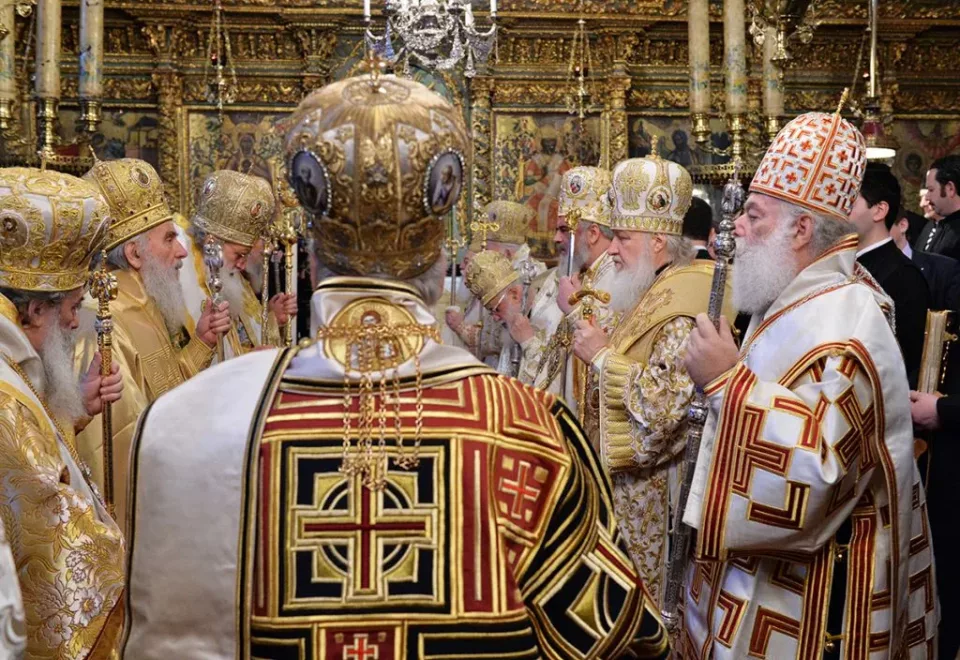
The hierarch of the Greek Orthodox Church, Metropolitan Seraphim of Piraeus, called for the convening of a Pan-Orthodox Council to resolve the Ukrainian church crisis. Prior to this, the hierarch made a report in which he directly identified the reasons that led to the current situation. He did not hesitate to mention the claims of Patriarch Bartholomew to the “Eastern papacy,” pointing out that the crisis in Ukraine occurred because the head of Phanar decided to resolve this issue not in a conciliar manner, but individually. In addition, the bishop emphasized the dubious canonical status of the OCU, given the well-founded claims to the apostolic succession of the clergy of this organization.
What do we have in this case? Some may say that the hierarch did nothing special, but this is not the case. First of all, we are talking about a bishop of the Church of Greece, which officially recognized the OCU and part of whose clergy, including the Primate, concelebrates with representatives of the Ukrainian schism. Secondly, given the tone and specificity of the statements, we can say that the Metropolitan of Piraeus put himself at risk, as he spoke out not only against the position of his own Church, but also against Patriarch Bartholomew, who enjoys unquestioned authority in the Greek world. Given the recent scandal with the deposition of Metropolitan Tychicos of Paphos (Church of Cyprus), which, according to media reports, took place at the request of the head of Phanar and because of the bishop’s steadfastness in preserving the canonical order in Orthodoxy (he criticized excessive ecumenism with Catholics and the creation of the OCU), it is quite possible that the Metropolitan of Piraeus risks repeating the same fate with his attacks.
What does this mean? The hierarchs of the Local Orthodox Churches are less and less afraid to criticize the OCU and the actions of Patriarch Bartholomew in this matter. After six years, as Metropolitan Seraphim correctly noted, not a single Local Church (except for the four Greek patriarchates) has recognized the OCU, which indicates their attitude to the Ukrainian schism. At the same time, from time to time, one or another prominent figure of world Orthodoxy will speak out in defense of the Ukrainian Orthodox Church, criticizing the Ukrainian government and the OCU for attempts to destroy the UOC. The statements of the Primates of Jerusalem, Serbia, Bulgaria, Poland, and other primates are worthy of note, as they remain unwavering in their attitude toward the OCU. In this regard, any wrong step in this case will nullify all their work, make the risks unjustified and shake the authority of the Ukrainian Orthodox Church as a Confessing Church in the Orthodox world.
That is why, as Metropolitan Seraphim said, it will not be possible to resolve the Ukrainian church crisis except through a pan-Orthodox discussion of this issue. The Primate of the Russian Orthodox Church has also recently expressed his readiness to solve church problems in a conciliar manner. One can lose count of the number of times representatives of other Local Churches have spoken about this. Everything rests on only one person, Patriarch Bartholomew, and judging by the signals coming from Phanar, his position on this issue may well change. It is possible that, by the grace of God, we will remember the 1700th anniversary of the First Ecumenical Council not for shameful flirtations with Catholics, but for the restoration of the conciliar system in Orthodoxy and the resolution of the most serious schism in the last hundred years.
Read also