Sweden Relocates 672-Ton Lutheran Church Due to Ground Collapse Threat
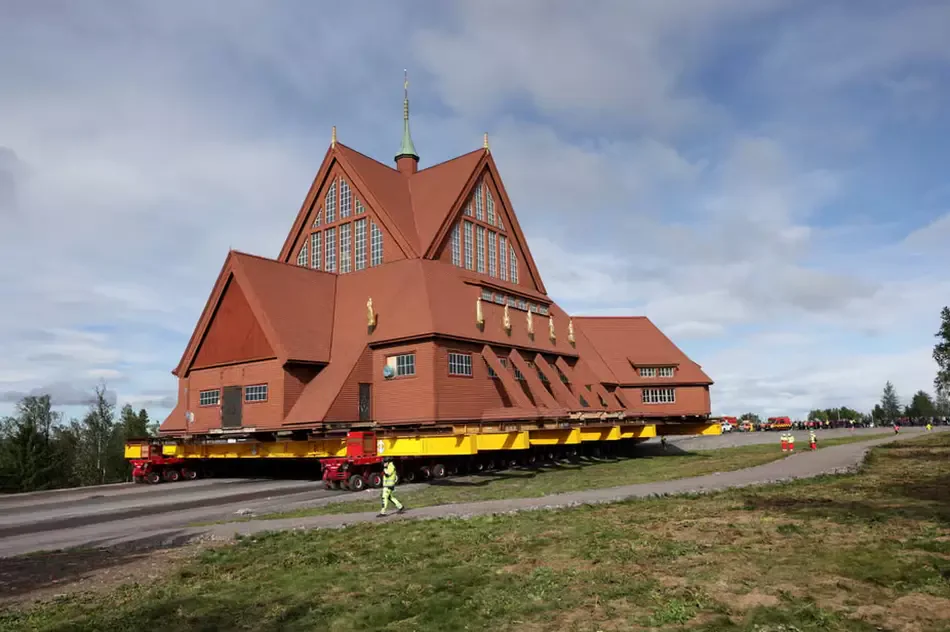
In the northern Swedish town of Kiruna, a unique operation was completed to relocate a Lutheran church built in 1912. The 672-ton, 35-meter-tall building was moved five kilometers because of ground subsidence risks caused by more than a century of iron ore mining. The news was reported by The Guardian.
The relocation began on August 19 and lasted two days. The church was transported at a speed of about half a kilometer per hour, while thousands of locals and tourists, as well as Sweden’s King Carl XVI Gustaf, observed the process. The event was broadcast live. Kiruna Church, recognized as the most beautiful building in Sweden constructed before 1950, will reopen to visitors at the end of 2026.
Preparations for the move took more than eight years and cost about $52 million. To enable transportation, city streets had to be widened. Next week, the church’s bell tower is scheduled to be relocated. Overall, LKAB, the state-owned mining company, is funding the relocation of the entire town, as mining operations at depths exceeding one kilometer threaten Kiruna’s historic center.
Kiruna, founded 120 years ago due to its mine, is now undergoing a large-scale relocation. In total, 23 cultural landmarks are to be moved, including the clock tower of the old town hall. Some buildings have already been demolished and rebuilt, while others are being moved in their entirety. The total cost of the relocation project is estimated at nearly $1 billion, with completion planned by 2035.
Earlier, it was reported that the Anglican Church of St. Mary in Somers Town, northwest London, will receive £639,000 from Historic England for urgent repair works. The Grade II-listed building is in very poor condition and at risk of demolition.
Read also