Filaret Denisenko publishes "spiritual testament" rejecting OCU and calling for creation of independent church
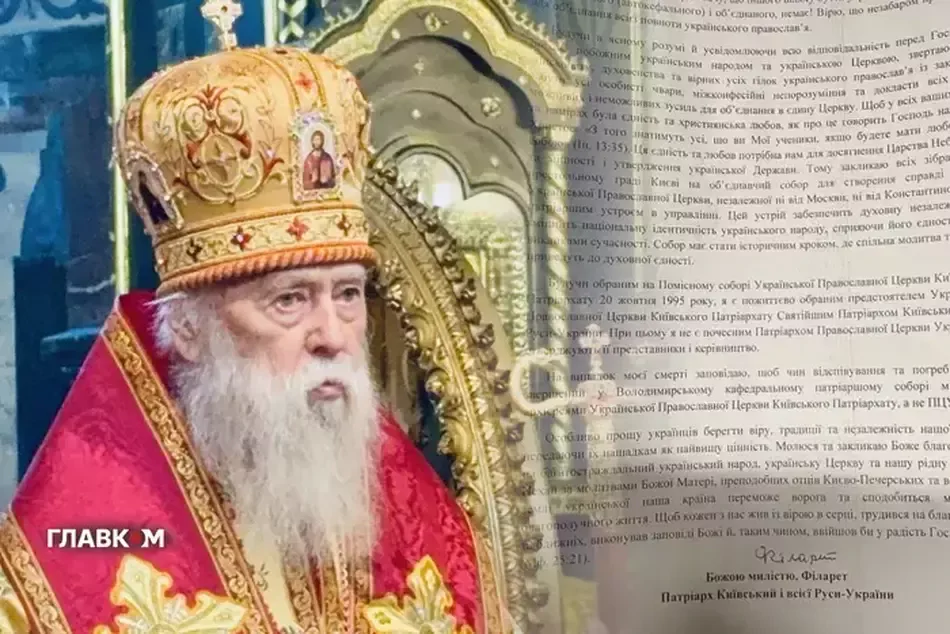
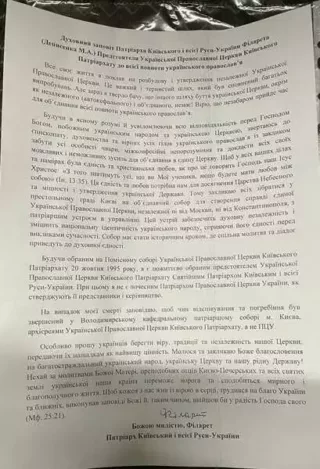
The head of the UOC-KP, Filaret Denisenko, has made public his «spiritual testament.» In the document, timed to coincide with the 30th anniversary of his «patriarchal ministry,» he reaffirmed his rejection of the OCU, reiterated his call for the unification of all branches of Ukrainian Orthodoxy to create a church independent of Moscow and Constantinople, and outlined his instructions in the event of his death.
According to Glavkom, the central call of the will is «the unification of all branches of Ukrainian Orthodoxy.» Denisenko appealed to the «bishops, clergy and believers» to «forget all personal quarrels, interfaith misunderstandings and make every possible and impossible effort to unite into a single church.»
To achieve this goal, Filaret called for the convening of a new unification council in Kyiv. According to the document, its task should be to create «a single Local Church, independent of both Moscow and Constantinople, with a patriarchal governance structure.» This point emphasizes his disagreement with the structure and status of the OCU.
In the text, Denisenko once again confirmed his status, emphasizing that he is the life-long elected «Primate of the Ukrainian Orthodox Church of the Kyiv Patriarchate» and not the «Honorary Patriarch » of the so-called Orthodox Church of Ukraine.
The final part of the document specifies instructions in case of his death. Filaret bequeathed that the funeral and burial rites be performed exclusively by the hierarchs of the UOC-KP at St. Volodymyr’s Cathedral in Kyiv, without the participation of representatives of the OCU.
Oleksandr Pivovarsky, chief specialist of the Department for the Protection of Cultural Heritage and Religions of the Department of Culture and Tourism of the Zhytomyr Regional Administration, said that the Kyiv Patriarchate, headed by Filaret Denisenko, has not legally ceased to exist, as the head of the UOC-KP has not handed over the constituent documents. In this regard, a large number of UOC-KP communities still exist in the state register.
Read also