"AFU, Church and SBU": the "Razumkov Center" published the results of a sociological survey on the level of trust of Ukrainians to social institutions
According to the latest data of a sociological survey conducted by the Razumkov Center, the Ukrainian Armed Forces continue to hold the position of the most trusted institution among citizens, while the level of trust in the Verkhovna Rada remains extremely low. Interestingly, the Church is trusted by 65% of respondents, which puts it on a par with the Security Service of Ukraine. The results of the survey were published on the website of the Razumkov Center.
According to the survey, the Armed Forces of Ukraine remain the unequivocal leader in terms of trust, trusted by 92% of respondents. High indicators are also demonstrated by the State Emergency Service (86%), volunteer organizations (81%), volunteer units (78%), the National Guard of Ukraine (72%), the Main Directorate of Intelligence (71%) and the State Border Guard Service (70.5%). Along with the Security Service of Ukraine (65%), the Church has a significant level of trust of citizens (65%). Among other institutions that arouse trust of the majority are public organizations (64%), the Ministry of Defense (63%) and the National Bank of Ukraine (54%).
The survey also revealed that some institutions enjoy trust that exceeds distrust, although not so significantly. These include the head of a city (settlement, village) (50% trust vs. 42% distrust), local council (49.5% vs. 41%) and the Verkhovna Rada Commissioner for Human Rights (48% vs. 34%). For the President of Ukraine and Ukrainian mass media the levels of trust and distrust are almost equal (48% of trust and 45% of distrust each), a similar situation is observed with the State Bureau of Investigation (40% of trust vs. 42% of distrust).
A significant proportion of Ukrainians express distrust in a number of key state structures. The lowest trust indicators are recorded in the Verkhovna Rada of Ukraine (76% of distrust), the state apparatus (officials) (75%), the Government of Ukraine (73%), political parties (71.5%), courts (66%) and the Prosecutor’s Office (60%). The political opposition is distrusted by 59% of respondents, and the Ukrainian government as a whole – by 57%. Among other institutions where distrust prevails over trust are the National Agency for the Prevention of Corruption (50% distrust vs. 32% trust), commercial banks (50% vs. 35%), the National Police (49% vs. 45.5%), the Specialized Anti-Corruption Prosecutor’s Office (47% vs. 37%), the National Anti-Corruption Bureau of Ukraine (45% vs. 41%) and trade unions (42% vs. 30%).
Sociologists note that in the first months after the outbreak of a full-scale war, citizens’ trust in most government institutions increased due to the need for national consolidation. However, over time this level has declined compared to the first year of the war, although it remains above the pre-war level for many institutions. A high level of trust remains primarily in those structures that are directly responsible for the country’s defense. The study involved 2008 respondents aged 18 and older, the theoretical error of the sample does not exceed 2.3%.
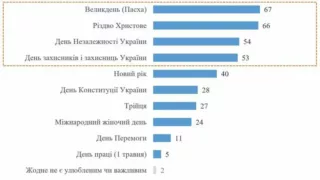
We shall remind you that earlier we reported that a new sociological survey conducted in Ukraine revealed a high level of religiosity of the population: more than 90% of citizens believe in God or a higher power. The survey also showed that Ukrainians consider the family a key institution for preserving traditions, and the most significant holidays for the nation are Easter and Christmas.
Read also