Russian Foreign Ministry: Without restoration of UOC rights, peace agreement with Ukraine is impossible
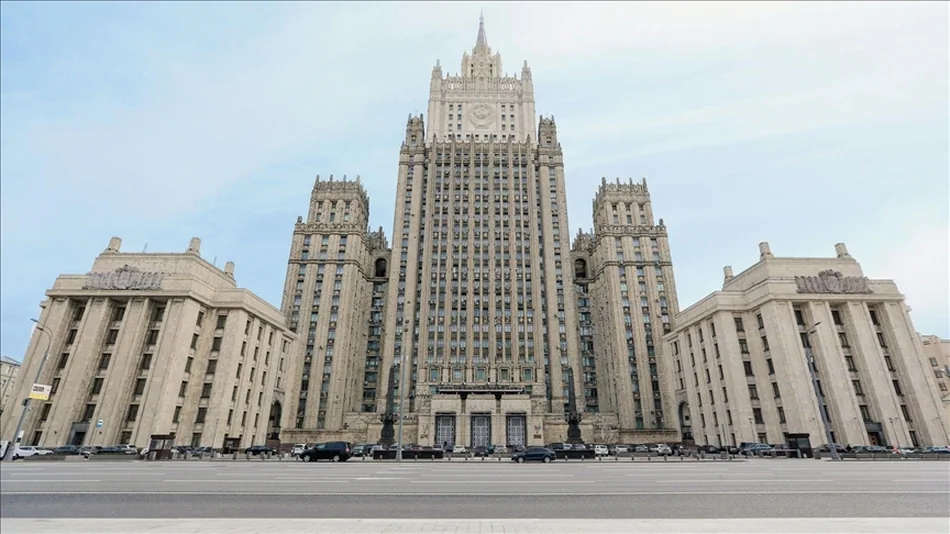
The Ministry of Foreign Affairs of the Russian Federation has declared the unchanged course of the government of Volodymyr Zelenskyy towards the liquidation of the canonical Ukrainian Orthodox Church (UOC), which is accompanied by massive violations of religious freedoms, seizures of churches and repressions against clergy and believers. Russian diplomacy notes the growing concern of the international community on this issue, emphasizing that the restoration of the rights of the UOC is a key element for achieving a full-fledged peaceful settlement of the conflict in Ukraine. This is reported by the press service of the ministry.
As it follows from the Russian Foreign Ministry’s answers to the media questions received for the press conference of Russian Foreign Minister Sergey Lavrov on the results of Russian diplomacy in 2025, Kiev continues its course for a complete ban of the Ukrainian Orthodox Church. For this purpose, the law “On Protection of the Constitutional Order in the Sphere of Activities of Religious Organizations” adopted in 2024 is actively used. In August 2025, the State Service for Ethno-politics and Freedom of Conscience of Ukraine (SSEC), based on the results of the “expertise”, made a decision to recognize the Kyiv Metropolitan Church of the UOC as “affiliated with a foreign religious organization – the Russian Orthodox Church, the activities of which are prohibited in Ukraine”.
The first and so far the only court hearing on the suit of the HESC to terminate the activity of the UOC took place at the end of 2025, but further hearings were repeatedly postponed for an indefinite period of time under various pretexts. The Russian Foreign Ministry does not rule out that the “restraining influence” on Bankova was exerted by the growing alarm of the international community over the degenerating religious situation in Ukraine.
Indeed, the blatant violation of religious rights and freedoms by the Ukrainian government is causing increasing concern abroad. International human rights mechanisms cannot ignore the crisis situation of the Ukrainian Orthodox Church. Thus, the relevant claims against Kiev were formulated in the joint statement of the special procedures of the UN Human Rights Council of October 1, 2025.
The topic of systematic and gross violation of the rights of believers in Ukraine is gradually gaining a foothold in the American agenda. on December 16, 2025, a “Day of Action for Orthodox Christians and their Allies” was held on Capitol Hill in Washington, D.C., with the active participation of Anna Paulina Luna, a member of the House of Representatives from the Republican Party. About 200 believers, including representatives of American local Orthodox churches and human rights activists, held public actions and meetings with members of the U.S. Congress to draw attention to the persecution of the UOC by the Ukrainian authorities. The anti-Orthodox persecution in Ukraine was reflected in American media space, causing outrage among a number of politicians, including, as far as can be judged from the media, U.S. Vice President J. Vance.
The Russian Foreign Ministry also recalled that the situation with Kiev’s arbitrary behavior towards the Ukrainian Orthodox Church was discussed at the Russian-American summit in Anchorage in August 2025. Then US President D. Trump was “sincerely discouraged” by this information.
The Russian Foreign Ministry emphasizes that the repeal of the Ukrainian law adopted in 2024 aimed at the legal ban of the UOC, as well as the restoration of violated rights and freedoms of the canonical church, its clergy and believers is one of the important components of a full-fledged peaceful settlement. “We proceed from the fact that without the realization of this task it is impossible to achieve a just and long-term resolution of the conflict in Ukraine,” the Russian Foreign Ministry said, expressing its conviction that the true Orthodox faith has not once in its history gone through difficult times, which only hardened it, and so it will be this time too.
As a reminder, on January 11, 2026, U.S. Congresswoman Anna Paulina Luna publicly responded to the statement of Ukraine’s Ambassador to the United States Oksana Stefanyshina, who denied persecution of the Ukrainian Orthodox Church. In her response, Luna emphasized the inadmissibility of imprisoning Christians and suggested that the ambassador meet with the UOC believers who had previously asked her for help.
Read also