On the Issue of Mobilizing the Clergy of the Ukrainian Orthodox Church
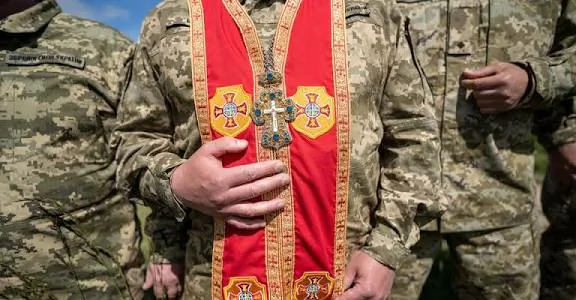
What once seemed impossible has become a stark reality over the past two years. Priests of the Ukrainian Orthodox Church (UOC) are being subjected to forced mobilization—without the right to deferment enjoyed by members of other denominations, and without the right to alternative service. Brutal. Harsh. Disrespectful. The most paradoxical thing is that a mobilized UOC priest—neither before being sent to the front, nor while serving, nor even after dying on the front lines—becomes a Hero of Ukraine, as is traditionally the case for ordinary citizens of the country.
Moreover, there are known cases where the church in which the priest served prior to mobilization is quickly seized by representatives of the OCU, apparently without fear that when the priest—now a soldier on the front lines—returns from the war, – he might take revenge on them, using his status to his advantage. In other words, the status of a UOC priest in Ukrainian society effectively nullifies such a person’s merits in principle, no matter how great they may be. Conversely, the status of a front-line soldier for a UOC priest—even if he has received the highest military award—does not guarantee that his basic civil rights and freedoms will be respected upon his return on leave.
Leaving the poetic aside, it should be noted that as of today, several hundred UOC clergymen are serving in the ranks of the Armed Forces of Ukraine (according to various estimates, between 300 and 500 people). All of them, having gone through the mobilization process, have found that the Church—which positions itself as the largest denomination in Ukraine—is unable to provide even basic legal protection, even though the UOC’s legal apparatus is quite active—for example, when it comes to protecting property rights. In other words, the UOC’s Legal Department has the resources, the capacity, and the willingness to defend a certain cathedral in the Diocese of N., but not to stand up for a priest.
Archbishop Silvestr (Stoychev), rector of the Kyiv Theological Academy and Seminary, who has recently taken on the role of one of the UOC’s key spokespeople, wrote the following regarding the mobilization of priests:
In November 2025, a procedure for reserving clergy was introduced. This exemption is processed through the State Service of Ukraine for Ethnic Policy and Freedom of Conscience (DESS). However, the Ukrainian Orthodox Church was not included in the list of religious organizations classified as critically important. Therefore, unfortunately, the clergy of our Church cannot apply for a deferment through the DESS. Furthermore, priests of the UOC cannot serve in the Armed Forces of Ukraine as chaplains.
Therefore, it is important to clearly understand that, from a legal standpoint, the Territorial Recruitment and Social Support Centers (TRSSCs) have the right to mobilize any clergyman of the UOC who is under 60 years of age and does not have a formal deferment. Here we must be frank: the very fact of mobilizing such clergy does not contradict current legislation. The state determines the rules of mobilization. In this situation, the Church can call on priests to comply with national legislation, but also to protect their conscience from a direct violation of Christian doctrine in cases of mobilization.
If we translate what the bishop said from academic language into plain language, it turns out that the Church leadership has resigned itself to state discrimination against UOC clergy, effectively handing them over to be mocked by the TRC’s mobilization teams. In other words, if the state has determined that UOC priests are not entitled to a deferment from mobilization, then that is how it must be, and it is normal. At the same time, Archbishop Sylvester noted that if a priest, deacon, or monk has not undergone the medical examination procedure, has not secured a deferment for himself, or has been placed on a wanted list, then these are his personal problems. As for “preserving one’s conscience from a direct violation of Christian doctrine in cases of mobilization,” it seems that only those who have actually faced this mobilization have the right to speak on the matter—and that certainly does not include the rector of the Kyiv Theological Academy and Seminary.
Be that as it may, the Synodal Legal Department of the UOC was mentioned above for a reason. The main complaint in this case is directed precisely at the “servants of Themis.” Is it really true that over the past two years it was not possible to at least begin developing legal mechanisms that could protect UOC priests from discrimination and arbitrariness at the state level?
There is such a concept as judicial precedent, which is formed in the course of court proceedings on various issues. The Synodal Legal Department of the UOC is well aware of what this is and knows how to work with it. However, during the years when the mobilization of priests has become common practice, the UOC has not filed a single lawsuit against the State Military Registration and Enlistment Office (GESS) or even the Territorial Military Commissariat (TRC), that would directly point to the unconstitutional discrimination against UOC priests compared to representatives of other religious organizations in the country, who were granted deferments from military service.
Some might say that such lawsuits would have been lost. That is quite likely. Just like all the other lawsuits the UOC is currently losing, which nonetheless help establish the very same legal precedent that can be invoked before international human rights organizations and European courts. However, this is not happening at all, and the issue of discriminatory mobilization of UOC priests is raised only in passing, giving way to other, more media-friendly cases. After all, it’s quite simple and transparent: a group has emerged in Ukraine that faces discrimination by the state precisely on the basis of religious affiliation, which violates both the Constitution of Ukraine and fundamental international law.
Thus, instead of defending its most important resource—its people—in court, the UOC is fighting over the walls of confiscated churches and monasteries. Of course, this is also important. But what good are “reclaimed” churches if there is no one to serve in them? Already, in some dioceses, a situation is developing where a priest with many children is forced to conduct services not only in his own parish but also in neighboring ones, given that the parish priests have been mobilized and are serving in the Armed Forces of Ukraine. Therefore, this problem is snowballing and could ultimately lead to a collapse and conflicts that cannot be resolved simply by ordaining new priests, since the “old” ones, who were mobilized into the Armed Forces of Ukraine, will eventually return to their posts—if, of course, there is anywhere to return to, given the general trend.
Read also