'For the sake of mixed families': Phanar theologians call for a single Easter date with Catholics and Protestants
A group of Orthodox theologians of the Patriarchate of Constantinople gathered in Boston has issued a call to overcome the historical differences between Eastern and Western Christian traditions and unify the date of Easter in accordance with the Gregorian calendar. According to experts of the Phanar, the calculation of Easter according to the Julian calendar is an outdated practice, since the “old style” does not meet astronomical criteria. In addition, it is believed that moving the date of Easter to the “new style” will help to overcome the existing division in so-called mixed families, where spouses profess Orthodoxy and Catholicism/Protestantism.
In a publication published on the “profane” website Fos Fanariou, it is noted that the First Ecumenical Council in Nicea in 325 AD clearly defined the order of calculating the date of Easter: it should be celebrated on the first Sunday after the first full moon following or coinciding with the vernal equinox. This principle was intended to ensure the unity of Christians. In practice, however, Orthodox and Western Christians very rarely celebrate Easter on the same day. The main reason for the discrepancy, according to the authors of the idea, lies in the Orthodox Church’s use of the “outdated Julian calendar,” which lags behind astronomical phenomena and the more accurate Gregorian calendar by 13 days. This leads to the fact that the celebration of Orthodox Easter allegedly deviates further and further from the original rules of the Council of Nicaea.
In addition, according to the theologians of the Phanar, the issue of celebrating Easter according to the Gregorian calendar takes on a special urgency “in light of pastoral and ecumenical challenges. “ In North America, for example, most Greek Orthodox marry Roman Catholics or Protestants. Different dates for celebrating Easter, in this situation, “create significant difficulties for so-called ‘blended families,’ where children often do not have the opportunity to receive communion or celebrate the feast with both parents.” It is noted that a single date for Easter could supposedly greatly ease the burden of such families and promote Christian unity.
For the reasons mentioned above, the experts suggest a local approach: local ecclesiastical jurisdictions could ask their Mother Churches to exercise pastoral care. It is noted that the Patriarchate of Constantinople would not need the consent of the other Autocephalous Churches to allow its faithful in North America to celebrate Easter according to the Gregorian calendar.
Phanar theologians argue that the issue of the calendar is not dogmatic, but essentially pastoral. Historical precedents already exist: the Church of Finland (under the jurisdiction of the Patriarchate of Constantinople) celebrates Easter according to the Gregorian calendar, and some dioceses in the United States allow parishes to choose the calendar for fixed holidays “without prejudice to the unity of Orthodoxy.”
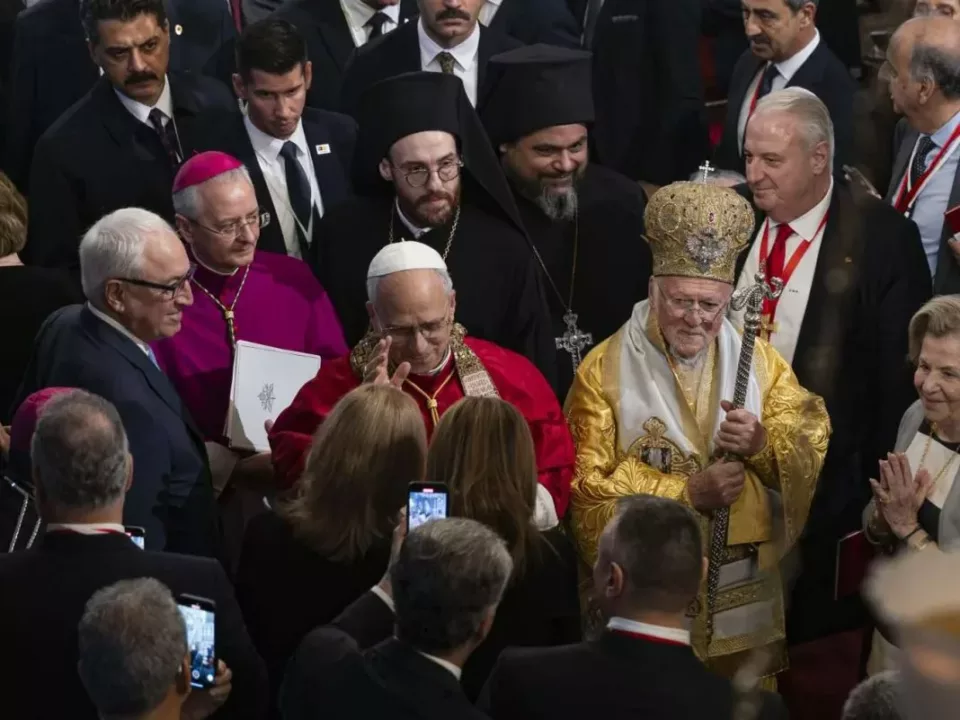
Recall, earlier we reported that the hierarch of the Hellenic Orthodox Church Metropolitan Seraphim of Kythira and Antikyphyria criticized the joint celebrations with Roman Catholics of the 1700th anniversary of the First Ecumenical Council, held in Turkey in late November 2025 under the auspices of the Patriarchate of Constantinople. The Hierarch noted that only one – except Patriarch Bartholomew – of the Primates of the Local Orthodox Churches was present at the celebration precisely because Pope Leo XIV took part in the event. In addition, Metropolitan Seraphim stated that it was inappropriate to sign a declaration of cooperation between the Patriarch of Constantinople and the Pope because of the significant contradictions in Orthodox and Catholic theology.
Read also