The third session of the Church Slavonic language course has concluded in Warsaw
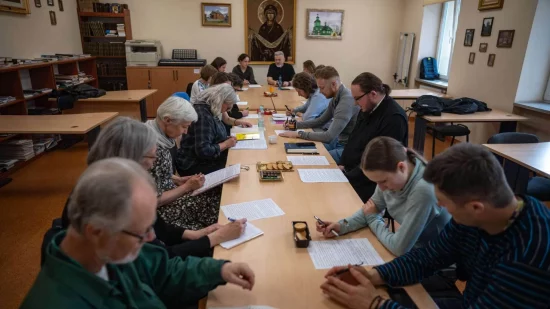
The third cycle of the Church Slavonic language course has concluded at the Orthodox Cultural Center in Warsaw. The classes were held during the 2025–2026 academic year with the blessing of His Beatitude Savva, Metropolitan of Warsaw and All Poland, and were led by Hegumen Panteleimon (Karchevsky).
According to the “Zhivot Tsrkve” portal, the final session took place on Tuesday, June 16, in the library of the Orthodox Cultural Center. Throughout the year, students of different generations gathered in the evenings to study Church Slavonic. Alongside participants from previous sessions, a significant number of new students joined the classes.
Depending on their level of proficiency, students were divided into two groups—beginner and intermediate. During the classes, they honed their skills in reading and understanding selected liturgical texts, prayer rules, and excerpts from divine services. Hegumen Panteleimon supplemented the analysis of the texts with accessible explanations of Church Slavonic grammar and vocabulary, as well as theological and linguistic commentary. The course was offered free of charge.
The completion of the course was marked by a prayer service of thanksgiving in the academic chapel of Saints Cyril and Methodius, the Equal-to-the-Apostles Brothers, at the Orthodox Cultural Center. The service was presided over by Hegumen Panteleimon, with the choir singing under the direction of Protodeacon Raphael Dmitruk.
The prayer service was attended by Archpriest-Stavrophore Anatol Shidlovsky, dean of the Warsaw district and rector of the Cathedral of St. Mary Magdalene, Equal-to-the-Apostles, in Warsaw. He congratulated the participants on a fruitful year dedicated to discovering the richness of the Church Slavonic language and thanked Hegumen Panteleimon for his efforts in continuing this important work. All participants were presented with a copy of Archbishop Jeremiah’s book of spiritual reflections as a gift.
The course participants expressed their gratitude to Metropolitan Savva for his blessing, to the Center’s director, Andrzej Lewczak, for providing the venue, and to Hegumen Panteleimon for the opportunity to gain a deeper understanding of the Church Slavonic language and the Orthodox theological tradition.
The Church Slavonic language emerged in the 9th century based on the South Slavic dialect spoken in the vicinity of Thessaloniki. The first writing system for this language—Glagolitic—was created by Saints Cyril and Methodius, and their disciples later developed the Cyrillic alphabet. Since the time of the Holy Brothers’ Slavic mission, Church Slavonic has been the language of worship and prayer, uniting the Slavic Orthodox peoples for centuries.
The publication also notes the special connection between Church Slavonic and the Polish lands. For centuries, the Supraśl Monastery housed the Supraśl Codex—one of the most important Old Slavonic manuscripts, included in UNESCO’s “Memory of the World” register. Furthermore, the first Cyrillic incunabula were printed in Kraków in 1491 at the world’s first Cyrillic printing press, established at the initiative of the Orthodox nobility at the court of King Casimir IV.
Today, Church Slavonic remains the living language of prayer in the Orthodox Church and is also the subject of scholarly research at academic centers in various countries.
Read also