The Kyiv-Pechersk Lavra commemorated the destruction of 1918 amid new damage to the Cathedral of the Dormition
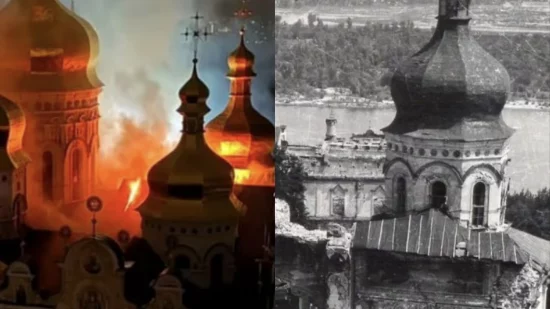
The Kyiv-Pechersk Lavra has published historical material on past destruction of the Cathedral of the Dormition and other holy sites of the monastery, drawing parallels between the current damage and the tragic events of January 1918. The publication emphasizes that the Lavra has repeatedly endured shelling, destruction, and periods of desolation, yet each time it was revived thanks to the monastic community’s prayer life and hard work.
According to the official website of the Kyiv-Pechersk Lavra, the images of the burning Assumption Cathedral struck a painful chord in the hearts of millions of people. The article notes that the current damage to this ancient holy site is not the first such tragedy in its history: more than a century ago, in January 1918, during the battles for Kyiv between Ukrainian troops and the Bolsheviks, the Lavra was already subjected to artillery fire.
According to the archival records cited, January 23, 1918, was particularly devastating for the monastery. The monastery’s diary records that the cannonade was directed mainly at the Lavra, with fire coming from the direction of Darnitsa and Nikolskyi Slobodky. The Assumption Cathedral, the Great Lavra Bell Tower, the printing house, the icon-painting workshop, the hospital, as well as the Near and Far Caves were all hit.
The publication provides an explanation for the shelling, as recorded in the diary entries: the incident may have been triggered by reports of alleged surveillance and machine-gun fire originating from the Lavra. At the same time, the author of the entry emphasized that no such actions had been taken by the monastery, and that the shooting might have been provoked by an unknown person located on the slopes near the Lavra’s fence.
The shelling had significant consequences for the Cathedral of the Dormition. One of the shells struck the upper cornice of the main altar, creating a breach and tearing off part of the roof. Another shell flew through a window into the altar area, damaging the furnishings and penetrating the brickwork of the arch. The St. Andrew’s side chapel was also pierced, the western dome was damaged, and part of the roof between the domes was torn off. A few days earlier, on January 20, a shell struck the dome of the Church of All Saints above the Economic Gate and then hit the wall of the Cathedral of the Dormition.
A separate section of the Lavra’s account notes that even amid constant danger, the monastery’s liturgical life continued uninterrupted. The diary entries mention liturgies, akathists, and services held amid the sounds of shelling. In particular, on January 17, when, as the chronicler noted, “bullets and shells whizzed in all directions, ” the traditional cathedral akathist was celebrated in the Cathedral of the Dormition.
The Lavra’s archives department emphasizes that the ability to maintain a life of prayer amid wartime conditions has become one of the defining features of the monastery’s history. Over its nearly thousand-year history, the monastery has repeatedly faced sieges, destruction, and tragedies, yet it has continued to live, serve, and rebuild.
The publication also notes that the damage to the Cathedral of the Dormition and other Lavra shrines is now perceived as more than just a loss to architectural heritage. For many believers, they have become a symbol of Ukraine’s suffering and the heavy losses the country is enduring due to the war. The Lavra emphasizes that this is not merely a historical building, but a place of prayer and a spiritual center that has been created and preserved by many generations of monks.
This article also marks the 38th anniversary of the resumption of monastic life at the Kyiv-Pechersk Lavra after decades of Soviet neglect. The publication states that it was the monastic community that undertook the task of bringing the holy site back to life, restoring the churches and buildings, and reviving traditions and unceasing prayer.
The authors conclude that the Lavra’s history shows that its revival has always begun not with the walls, but with prayer. Therefore, as noted in the article, there is reason to hope that the current damage will not mark the final chapter in the history of this ancient shrine, and that the monastery, as has happened before, will be restored.
Read also