The UOC's procession to Pochayiv showed that this religious organization remains a significant force in Ukrainian society - journalist
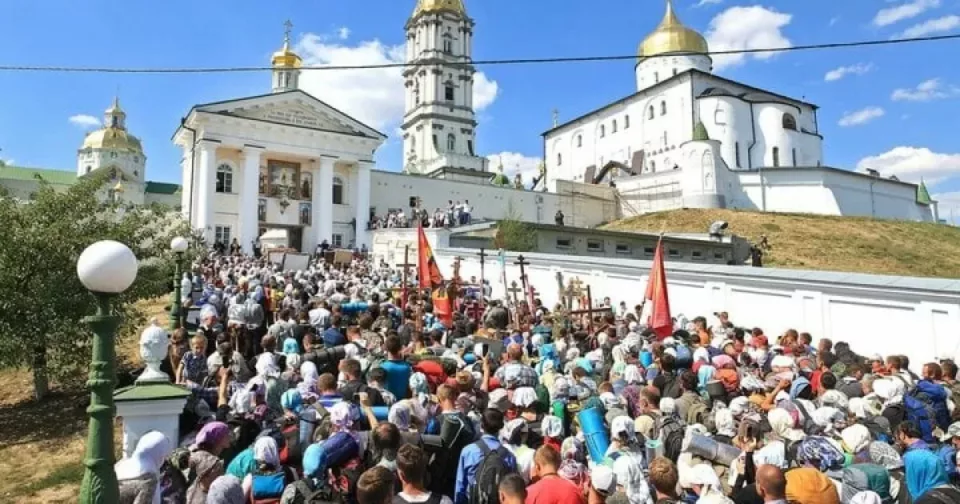
Ukrainian journalist Mykola Donchenko published an article in which he expressed his opinion on the legislative ban on the Ukrainian Orthodox Church. The journalist, using the example of the 30,000-strong Cross Procession from Kamyanets-Podilsky to Pochayiv, concluded that the UOC still has a serious influence in Ukrainian society, so the legislative ban on the Church is a rash decision. Donchenko’s article was published on the URAUA website.
“History demonstrates that bans on mass religious and ideological movements and any repression against them, even if such actions are due to the objective state of affairs, often have the opposite effect. A good example is the situation with the Solidarity movement in Poland in the 1980s. The Polish communist government banned the organization’s activities and even imposed martial law, but this did not destroy it, but, on the contrary, led to its underground growth and strengthened support among the population. Ultimately, this movement played a key role in Poland’s transition from a communist system to a democratic one. In this sense, if the government chooses to completely ban a religious organization, such actions may, on the contrary, provoke the mobilization and activation of its supporters. We can already see that the president’s decision has not weakened the desire of believers to associate themselves with the Russian patriarchate, but has only provoked a response. For example, in August of this year alone, about 30,000 representatives of this religious organization took part in a seven-day procession from Kamianets-Podilskyi to the Holy Dormition Pochayiv Lavra on the occasion of the Assumption of the Blessed Virgin Mary. And this is taking into account the current restrictions, which included a ban on the procession by the regional military administrations of Khmelnytsky and Ternopil regions, as well as the decision of the regional council to use the Pochayiv Lavra by the UOC-MP faithful,” – Donchenko reflects.
The journalist added that the Ukrainian Orthodox Church, despite the pressure and bans, can still mobilize human resources, which clearly indicates the influence of the Church on Ukrainian society. Donchenko believes that in this regard, the UOC should not be banned, but allowed to continue functioning, but under state control.
“In this sense, despite the different attitudes of Ukrainians and representatives of the central government towards the UOC-MP faithful, this event demonstrated that this religious organization remains a significant force in Ukrainian society and has a significant influence. Based on this objective state of affairs, it is also important to understand that for most people, religion is not a political issue, but a part of their cultural and national identity. Therefore, a more effective option would be not to “fight” against the UOC by engaging its members in political activities against Ukraine, but rather to allow them to run their own affairs with the support of the state. Any attempts to restrict the activities of the UOC may be perceived by its followers as a threat to their basic values and rights. As a result, instead of weakening the position of the institution, the authorities risk provoking a wave of discontent among believers, which could lead to an increase in social tension. Moreover, open antagonism can help Russian propaganda to use church issues in Ukraine to destabilize society, and the special services of the enemy state to recruit new supporters,” – the journalist concluded.
Earlier, we reported that the Center for Countering Disinformation under the National Security and Defense Council of Ukraine published a statement claiming that the Ukrainian Orthodox Church overestimated the number of participants in the annual religious procession from Kamianets-Podilskyi to Pochayiv, which took place from August 19 to 25, 2024. The National Security and Defense Council claims that instead of the claimed 30,000 participants, only about 5,000 people took part in the procession.
Read also