"New poll": 80% of Ukrainians allegedly support the ban of the Ukrainian Orthodox Church
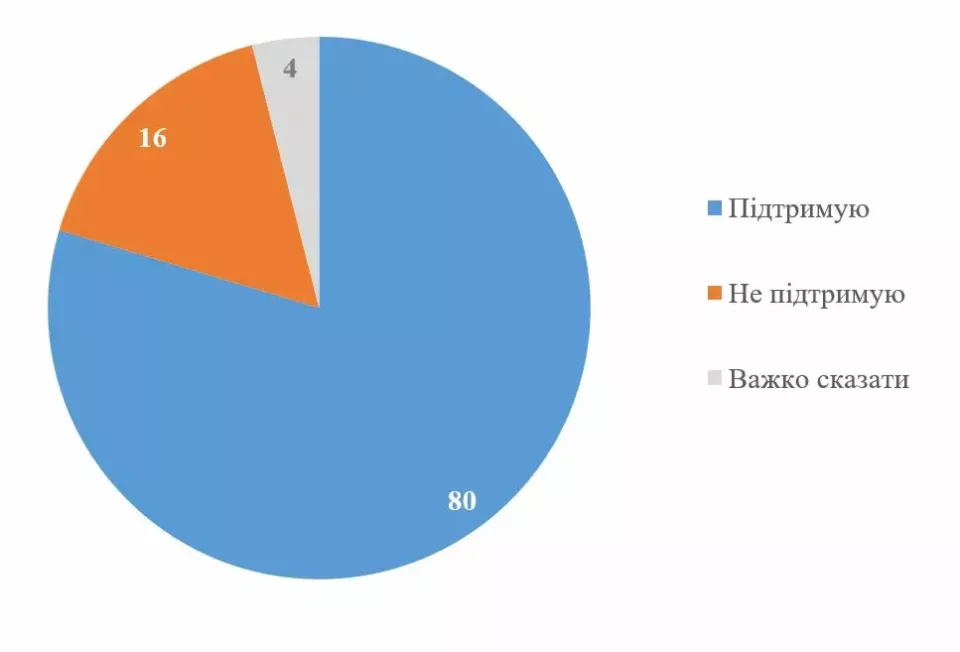
The Kyiv International Institute of Sociology (KIIS) has published data from a new opinion poll, according to which the majority of Ukrainians allegedly support the ban on the Ukrainian Orthodox Church. According to the published data, 80% of Ukrainians support the ban of the UOC, 70% consider themselves to be members of the OCU, and 61% of citizens voted for the creation of the Single Local Church on the basis of the OCU. The report is published on the organization’s website.
“Compared to July 2022, religious self-identification has hardly changed. The majority of Ukrainians – 70% – consider themselves Orthodox. Among them, the largest number – 56% of all respondents – identify themselves with the Orthodox Church of Ukraine, which is 81% of all Orthodox residents of Ukraine. Another 7% identify themselves as Orthodox “without specification” and 6% as the Ukrainian Orthodox Church of the Moscow Patriarchate. This is followed by atheists (12%) (it should be noted that among the “other” answers, some respondents said they were “agnostics,” “non-believers,” etc., i.e., they did not want to identify themselves as “atheists,” but named some close identifications) and those who identify themselves as the Ukrainian Greek Catholic Church (7%). Other options were chosen by no more than 3% of respondents,” – the KIIS report says.
In addition, the institute reported that the majority of Ukrainians support the idea of creating a single local church in the country, which should be created by merging the Ukrainian Orthodox Church and the OCU.
“The majority of Ukrainians – 61% – support the idea that there should be only one Orthodox Church in Ukraine. 16% do not support it, and another 20% do not care about this issue. Among the possible options for unification, the most supported is the approach when the hierarchs and ordinary priests of the UOC-MP join the OCU and become part of it. Overall, 71% of respondents have decided on their opinion on this issue. Among them, the majority – 78% – supported this approach in general (in terms of the total population, this is 55%). The majority of respondents believe that such accession is possible only for hierarchs and ordinary priests of the UOC-MP who have not tainted themselves with ties to Russia. This option is supported by 47% of all respondents and 66% of those who have not decided on their opinion on this issue. The option where all the hierarchs and priests of the UOC-MP simply join the OCU and become part of it was supported by 8% of all respondents and 11% of those who have decided,” – the Institute of Sociology added.
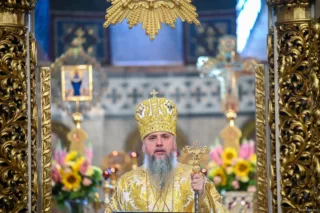
The survey also notes that the majority of Ukrainians want the current head of the OCU, Epiphany Dumenko, to become the head of the unified church if it is created. Between 6 and 9 percent of respondents allegedly spoke in favor of the Metropolitan of Kyiv and All Ukraine.
“When asked which of the hierarchs best suits the position of the head of the unified Orthodox Church, Epiphany retains unequivocal leadership – 50% of all respondents would like to see him as the head of the unified Orthodox Church (76% of those who have decided on their opinion). This is followed by such options as another hierarch from Ukraine (8% of all respondents and 12% of those who have decided), Onufriy (6% and 9%, respectively), and another hierarch from outside Ukraine (2% and 3%). One-third of respondents said they had no opinion or were indifferent,” – the report says.
It should be noted that the Kyiv International Institute of Sociology regularly publishes manipulative polls, on the basis of which it forms public opinion about the Ukrainian Orthodox Church in a negative way. For example, we recently reported that on the eve of a new wave of banning the UOC in the Verkhovna Rada, KIIS published the results of a survey on “What should be the government’s policy and trust towards the Ukrainian Orthodox Church of the Moscow Patriarchate”, knowing full well that there is no religious organization of that name in Ukraine. Taking advantage of the UOC’s obviously negative association with Russia, KIIS obtained a result of 63% of those who voted in favor of banning the UOC. However, later the State Service for Ethnic Policy and Freedom of Conscience published statistics on religious communities in Ukraine. In total, the SSERF counted 36,195 religious communities, 552 monasteries, and 201 religious educational institutions. The Ukrainian Orthodox Church has the largest number of registered and active communities.
Read also