The DESS recalled the "dialog of church, state and society"
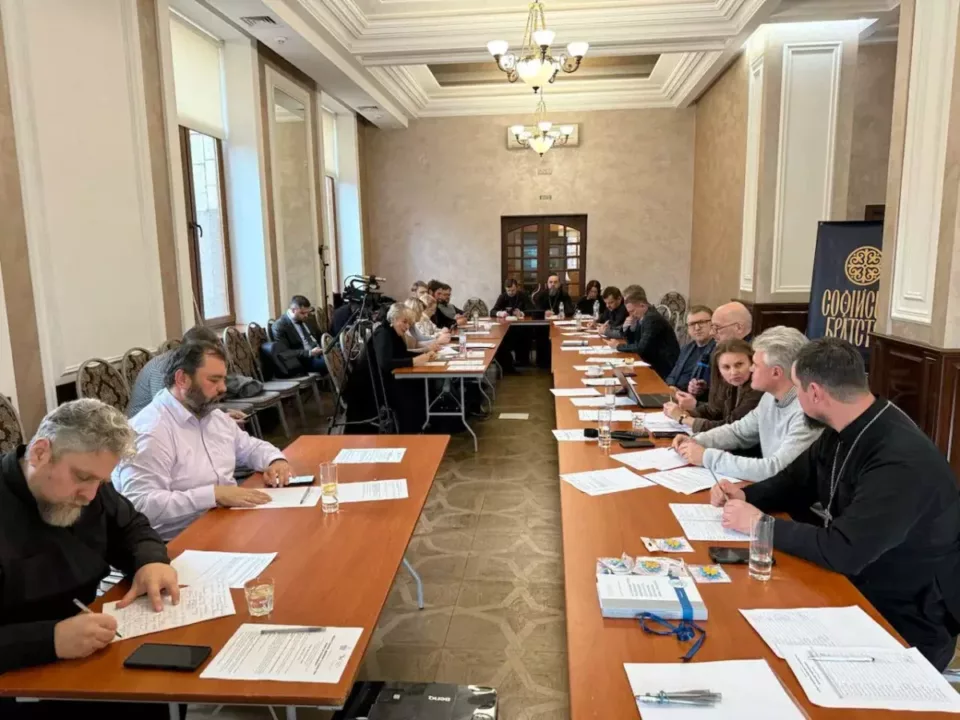
on December 10, 2025, a discussion entitled “Dialogue of Church, State and Society: Ways to Understanding” was held in Kyiv. The event, organized by the State Service of Ukraine for Ethno-politics and Freedom of Conscience, was attended by representatives of the UOC, the OCU, mass media, public organizations and specialized state institutions.
According to the State Service of Ukraine on Ethnopolitics and Freedom of Conscience, the first part of the discussion was devoted to moral and ethical aspects of legislative decisions, the responsibility of religious organizations and the state, as well as the need to protect the dignity of believers and prevent radicalization in the religious environment. Victor Elensky, head of the GESS, emphasized the significant humanitarian and chaplaincy contributions of religious communities, which unfortunately often go unnoticed due to the media’s focus on conflict.
Yelensky also explained the logic behind the adoption of the anti-church law No. 3894 “On Protection of the Constitutional Order in the Sphere of Religious Organizations,” noting that this document is a response to Russia’s attempts to use religion to subvert Ukraine. He assured that the law does not violate the freedom of conscience, and all final decisions on it are made exclusively by the court.
Particular attention was paid to the situation with the Kyiv Metropolitan Church of the UOC, where the DESS revealed signs of affiliation with the Russian Orthodox Church and issued an instruction to eliminate these ties. The requirements, according to the official, did not concern doctrine or liturgical practice, but “exclusively legal and organizational aspects – actual withdrawal from subordination to Moscow, informing the faithful, ceasing participation in the ROC bodies and abandoning the charter that formally binds the UOC to the Russian church structure.” According to Yelensky, the UOC leadership has refused to comply with the order and is trying to drag out court proceedings, while the state is not demanding anything that contradicts the faith, but only an end to dependence on the structure that supports the war against Ukraine.
In the afternoon, the participants moved on to discuss practical mechanisms for mutual understanding in communities and the culture of dialog between different religious jurisdictions. Vyacheslav Gorshkov, Head of the Religious Affairs Department, emphasized that contemporary relations between the state, church and society are particularly sensitive and complex, as the war threatens not only state institutions, but also the very existence of Ukraine. He noted that a democratic model of coexistence is impossible without the partnership of these three spheres. Gorshkov also pointed to the need for “public theology” – the ability of churches to respond to real public demands and not to be locked in internal discussions.
To summarize, the participants concluded that each party should contribute to strengthening public unity: the state should strengthen institutional capacities, churches should develop internal dialogue and modernize their charters, and society and the media should promote media literacy, create an environment for dialogue, and “not distort religious issues by reducing them to conflicts. It is precisely such cooperation, according to the panelists, that can ensure healthy development of the religious sphere in Ukraine and strengthen society’s resilience to external threats.
We shall remind you that on November 18, the head of the State Service of Ukraine on Ethno-politics and Freedom of Conscience Viktor Yelensky met with the Prefect of the Dicastery for Eastern Catholic Churches, Cardinal Claudio Gugerotti, in the Vatican. During the dialog, the parties discussed the religious situation in Ukraine and the implementation of Law No. 3894 aimed at banning the Ukrainian Orthodox Church.
Read also