Operation “Wanish”: Who Is Trying to Tarnish Patriarch Bartholomew’s Reputation in the Orthodox World, and How?
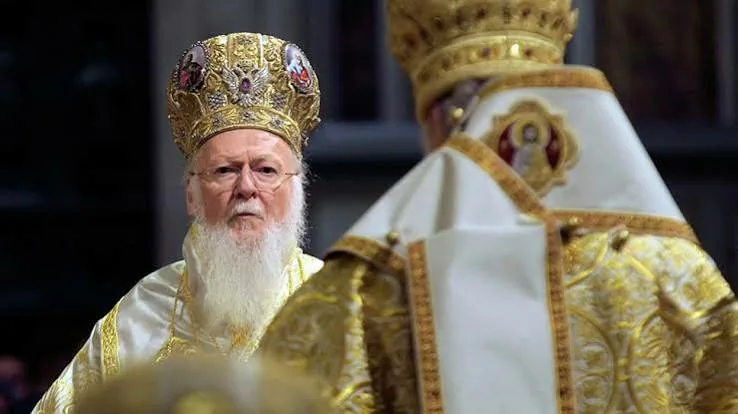
The creation of the OCU and its subsequent “free rein” have long since become a story in which people don’t just participate—they get themselves into trouble. And this time, it wasn’t just anyone who got himself into this mess, but Patriarch Bartholomew himself. Thanks to the OCU, he has, in essence, gained almost nothing of value, but has lost a great deal in terms of reputation. The very fact that the hierarchs of the Churches of Greece and Cyprus—who are heavily dependent on the Phanar—are openly opposing the legalization of the Ukrainian ecclesiastical schism speaks to the severity of the crisis. And the fact that the OCU exists even within these Churches under a regime of “hybrid recognition” definitively dashes Epiphany Dumenko’s hopes of entering the “big leagues” of Orthodoxy. Adding fuel to the fire is the position of most other Local Churches, which refuse to recognize the OCU as a church or Epiphany as a canonical bishop.
Nevertheless, the situation is not so clear-cut. A crisis-management mechanism has already been activated to save the head of the Phanar, and it involves figures whose authority could help Patriarch Bartholomew shift the blame for all the OCU’s “blunders” away from himself.
The actions of Patriarch Theophilos of Jerusalem play a distinct role in this story. His attempts to “fix what Bartholomew has done” have been ongoing for several years now. Counting from the OCU’s establishment, there have been at least five such incidents. First, the Patriarchate of Jerusalem itself does not recognize the OCU. At the same time, Theophilos has, in essence, not uttered a single harsh word about the OCU, and the Church of Jerusalem has not adopted any synodal or conciliar decisions on this matter. Second, the Amman meeting of Primates was an important step; it provided an outlet for all those outraged by Bartholomew’s actions in Ukraine and raised hopes for a repeat of this format. However, the matter never progressed beyond discussions.
Third, a visit by the Patriarch of Jerusalem to Moscow was announced for mid-June of this year. The official purpose of the meeting was never clarified, but it is not difficult to assume that the discussions would have centered on relations between the Churches and the Ukrainian issue. Later, with the personal support of the U.S. president, an even more ambitious plan emerged: Theophilos would allegedly serve as a mediator in resolving the war between Russia and Ukraine. However, this plan, too, remained merely a declaration of intent.
Fourth, Theophilus recently stated that he intends not only to act as a mediator in resolving the hostilities but also to meet personally with Vladimir Putin and Volodymyr Zelenskyy in order to reconcile the two warring states and—take note—heal the ecclesiastical schism. And here a key question arises: exactly which schism are we talking about? There is no schism between the Russian Orthodox Church and the Ukrainian Orthodox Church—there are disagreements that have arisen against the backdrop of the war, but the Russian Church still considers the Ukrainian Orthodox Church to be an integral part of itself. Consequently, one suspects that the term “schism” refers specifically to the OCU.
If Theophilos comes to Ukraine, then, according to protocol, the host side will inevitably bring Epiphany Dumenko along, with whom the Patriarch of Jerusalem will have to interact one way or another. He is unlikely to succeed in ensuring that Metropolitan Onufry represents the Church at such a high-level meeting. This means that if Theophilos speaks of healing the schism between the OCU and the UOC, the question arises: under what conditions should this take place? If he is met at the very highest level by an outspoken schismatic who, relying on administrative resources, continues to drive the canonical Church underground, wouldn’t this amount to a de facto hybrid recognition of the OCU? It is already easy to imagine how state media will turn such a meeting into a high-profile news story with the desired spin: namely, that Onufry, a stateless person, is holed up in Theophania, while Epiphany decides the fate of Ukrainian Orthodoxy.
In such a scenario, the question inevitably arises: what position will the Ukrainian Orthodox Church (UOC) find itself in? Will it not be in the position not merely of a victim, but of the losing side? And what, in general, will Theophilus be able to offer Ukraine if he fully understands that he lacks the authority to resolve such issues on his own?
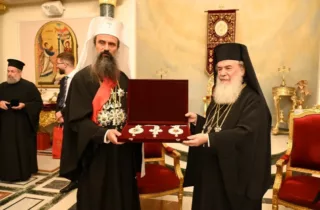
There is reason to believe that Theophilus will indeed visit both Russia and Ukraine, but this will not happen until after the meeting of the so-called Pentarchy, which Patriarch Bartholomew intends to convene in the near future. The Patriarch of Jerusalem recently met with the head of the Phanar, and the Pentarchy meeting itself may well be an attempt to substantively discuss the accumulated issues and develop a “road map” for resolving the Ukrainian church crisis. In that case, it is obvious: Theophilos will bring not his own decisions to Kyiv, but Bartholomew’s ideas.
And it’s not hard to guess what Bartholomew himself might propose. It all boils down to the argument: “We granted the Tomos to all of Ukraine” and similar formulations. The most he might be willing to do is suggest that the UOC and the OCU convene another council under the supervision of the same Pentarchy. But it is important to understand the main point: Bartholomew will never renounce the creation of the OCU nor revoke the Tomos. If the Pentarchy is indeed preparing precisely this scenario for Ukraine, then there are several possible ways to implement it.
First, it must be taken into account that new elites have already emerged within both the UOC and the OCU who are dissatisfied with the current state of affairs in their respective structures. It is precisely this internal “core” that could serve as the foundation for another attempt at unification. This could happen either through the “dismissal” of the heads of the UOC and the OCU and the election of a new “Metropolitan of Kyiv,” or through the promotion of a compromise figure who would satisfy both sides—for example, Mikhail Anishchenko, the Phanar’s exarch in Ukraine.
But what to do with those who disagree? And there will undoubtedly be dissenters, primarily within the UOC. For them, a “third way” could be proposed—full integration into the Russian Orthodox Church (ROC) as an exarchate or as separate dioceses, similar to the arrangements in Crimea and the Donbas. If you don’t want to join the OCU 2.0—then go to the Russian Orthodox Church and deal with the state and other detractors on your own.
Against this backdrop, the informational “preparatory campaign” is particularly noticeable. A narrative is increasingly appearing in church media claiming that Patriarch Bartholomew is allegedly not to blame for what happened because he established the OCU under political pressure, not of his own free will. Recently, Archimandrite Gabriel (Bunge), an authoritative figure in the Western Orthodox world, stated that the U.S. State Department had pressured the head of the Phanar. And today, several church media outlets published an extensive article featuring “recollections of those events” from representatives of the Patriarchate of Constantinople, which asserts that the OCU was established under pressure from Poroshenko and the SBU.
At the same time, Bartholomew is actively seeking the support of the heads of the Albanian, Bulgarian, and Romanian Churches, who, by all appearances, favor his course. All these coincidences seem suspiciously synchronized. And so one gets the impression that what appears to be help may in fact turn out to be a trap, while what seems like fantasy is, in fact, quite real.
Read also