"Mr. Onuphry": Why the UOC has no and cannot have allies in Phanar
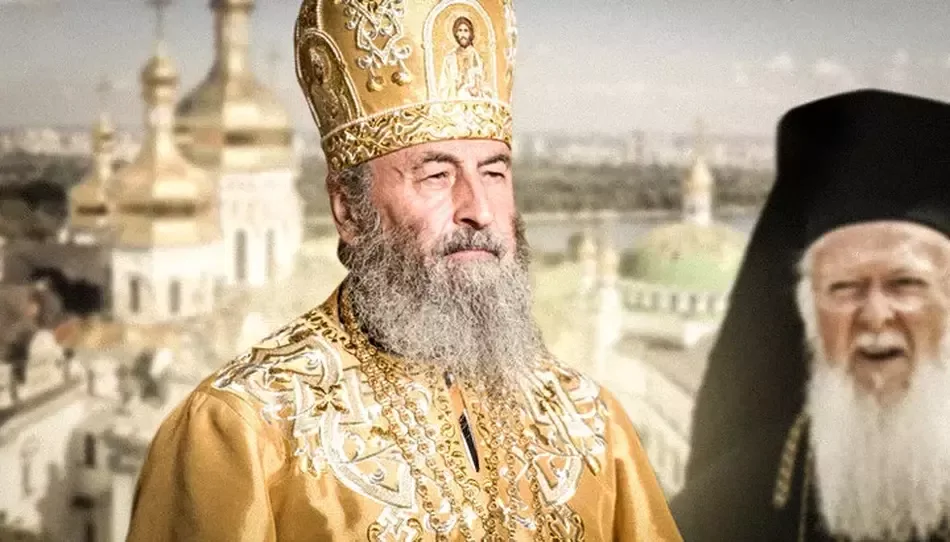
All last week there was a scandal with a letter from the head of the American Archdiocese of Phanar, Elpidophoros (Lambriniadis), addressed to Patriarch Bartholomew. The subject of this letter was opposition to the defense of the Ukrainian Orthodox Church in the United States, in which Archbishop Elpidophoros himself is directly involved.
It is worth noting that this letter is clearly at odds with Elpidophoros’ previous statements, as he has repeatedly made it clear that the creation of the OCU and, moreover, the activities of this organization in relation to the UOC raise many serious questions. It might even seem to some that the head of the American Archdiocese is trying to position himself as a friend or at least a sympathizer of the Ukrainian Orthodox Church. However, the facts that Elpidophoros casually shared in his letter reveal a completely different picture.
“Mr. Onuphry” and the “so-called” Churches
From the very first lines of the letter, the internal atmosphere that reigns in Phanar regarding the Ukrainian church issue becomes clear. The thesis that “Bartholomew tolerates the presence of the UOC hierarchs in Ukraine,” although never voiced by him personally, is obviously fully accepted in Hellenic circles. In the context of the above-mentioned letter, Archbishop Elpidophoros several times calls the Primate of the UOC “Mr. Onuphry,” thus showing complete disregard not only for the title, but even for the episcopal dignity of His Beatitude.
It is worth noting that such an arrogant attitude in the text of the letter is expressed not only to the Primate of the UOC, but also to other Local Churches that do not share Phanar’s position on the creation of the OCU and discrediting the UOC. For example, the Autocephalous Orthodox Church in America was labeled “so-called” and the ROCOR was almost called Russia’s spy agency abroad. In addition, Serbian Patriarch Porfirije has been accused of the notorious “ties to Moscow.”
It would be understandable if the representative of Phanar in the United States stopped there, but Archbishop Elpidophoros went even further, actually demonstrating the attitude of the Patriarchate of Constantinople towards other, even friendly, Local Churches. Here is what he wrote: “In a number of countries, the Bishops’ Assembly cannot even be convened, since the local bishops of a number of autocephalous churches from the so-called ‘mother churches’ have been given a clear instruction not to attend the assembly, which is chaired by the hierarchs of the Ecumenical Patriarchate, since it granted autocephaly to the Orthodox Church of Ukraine.”
All these “so-called” and “misters” are nothing more than a marker of Phanar’s attitude toward the rest of the Orthodox world. Formally, the unofficial gradation of the Local Orthodox Churches in the eyes of Constantinople can be defined as follows: “agents of the Kremlin” (Local Churches that did not approve of Phanar’s decision to legalize the church schism in Ukraine), “Churches” (those that are part of Phanar’s orbit and nod approvingly to all Phanar’s attacks), “so-called” (all those to whom Phanar did not grant autocephaly) and “misters” (people in cassocks who are not autocephalous Churches and do not want to follow Constantinople’s lead).
Naturally, if the Representatives of the Local Churches were not subject to political pressure from the pro-Phanar lobby in the United States, Archbishop Elpidophoros’ disgust with them could be a subject of discussion, but, as is customary in Orthodoxy, the majority will simply remain silent and pretend that nothing is happening. At the same time, the “epithets” with which the author of the letter “awarded” the Orthodox Churches clearly demonstrate Phanar’s attitude toward the rest: “you are nothing without us, and you are called in no way.”
“Brothers” are our elders
It is noteworthy that in his letter, Archbishop Elpidophoros noted the conditional allies of the Patriarchate of Constantinople. He included the Bulgarian, Georgian, and Romanian Orthodox Churches. According to the hierarch, the bishops and representatives of these patriarchates in the United States do not share the position of the Serbian or Antiochian patriarchates on the issue of persecution of the UOC.
Well… They do not share? Well, that’s fine. At least we are now convinced of what we had previously speculated and judged. With all due respect to the individual hierarchs, priests, and faithful of these churches, they need to understand that their church authorities do not view the Ukrainian church conflict as a threat to the unity of world Orthodoxy. At the same time, the UOC itself must realize that these patriarchates pose a threat to the number of Local Churches that are potentially inclined to recognize the Ukrainian church schism.
A little honey in a barrel of tar
Despite the unpleasant aftertaste that is felt after reading the letter, it is worth noting some good, extremely important points. First of all, it is encouraging that the number and quality of those who support the UOC in moderation is steadily increasing. And although Elpidophoros in his letter convinces Bartholomew to the contrary, opponents of the UOC have recently been extremely active in advocating for the reprisals against the canonical Church abroad. The fact that the persecution of the UOC has attracted the attention of a number of American congressmen, and that the United States is talking at high levels about violations of the rights of believers in Ukraine, is a wake-up call that cannot be ignored.
The second point worth paying attention to is the decision of the Synods of a number of Local Churches that have recently met and called for the convening of a Pan-Orthodox Council, including because of the church crisis in Ukraine. In particular, last week this was stated by the Jerusalem Patriarchate and the Polish Orthodox Church. The number of Local Churches that situationally support such an initiative at least remains unchanged, indicating the likelihood of such a scenario in the near future.
Unfortunately, the organization of such an event is unlikely to be possible during the lifetime of Patriarch Bartholomew. However, to face the truth, we must admit that an 86-year-old man who is rumored to have serious health problems will sooner or later face God and is unlikely to be able to control church processes for long. By the way, this is why the Greeks are creating some semblance of a hardware struggle between the key candidates for the patriarchal throne of Constantinople.
It’s no secret that the main confrontation is now between Archbishop Elpidophoros Lambriniadis and another, no less important figure, Metropolitan Emmanuel Adamakis. Interestingly, while Adamakis plays the role of a Phanar hawk and adheres to a tough stance on the interests of the OCU and the liquidation of the UOC, Lambriniadis in this situation acts as a “good policeman”, promoting ambiguous messages and ideas, up to the change of the OCU leadership to a more contractual one.
However, neither of them is ultimately a friend of the UOC. Although Elpidophoros advocates the idea of creating an exarchate for the UOC, it is obvious that this is only a half-measure, the ultimate goal of which is to integrate the canonical Church (or parts of it) into the OCU. Such an ideology indicates that in any future scenario, with or without the renewal of the Phanar’s leadership, the Ukrainian Orthodox Church will not appear on the Phanar’s church map, and therefore, the UOC has no friends in Phanar and cannot have any.
This idea, by the way, would be very useful for those from the UOC who are eager to restore communion with the Patriarchate of Constantinople. It is difficult to say what they promised you there, and whether they promised you anything at all, but there is a feeling that the good old principle of “promise them anything and cut them later” is at work in this case.
Read also