Academic Diplomacy
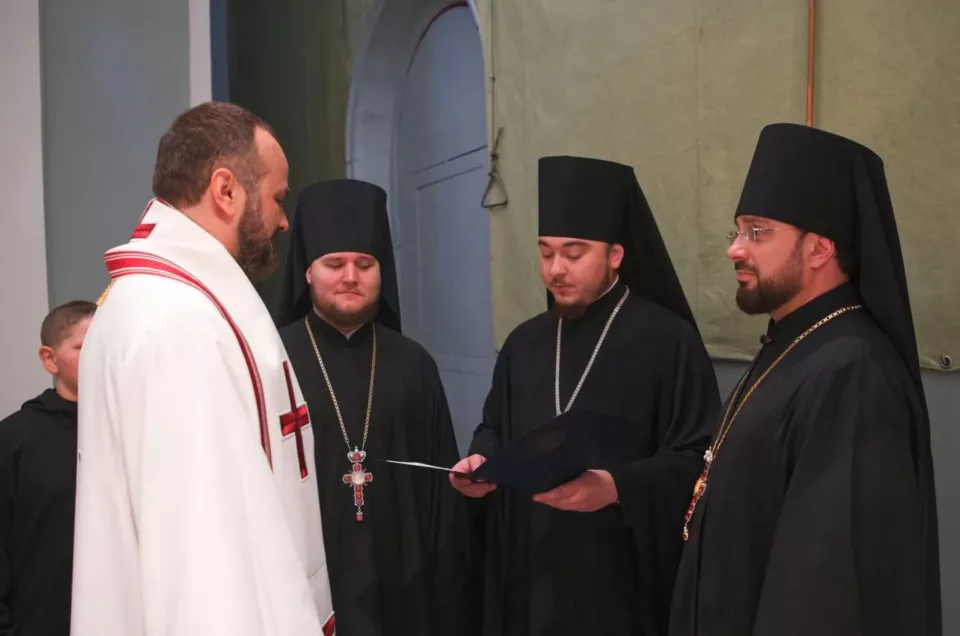
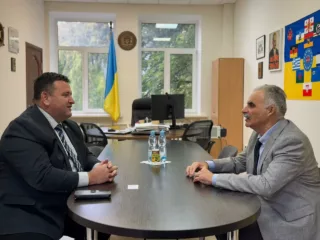
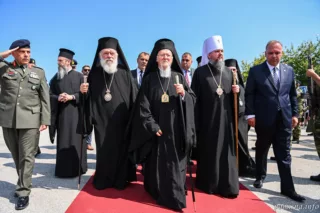
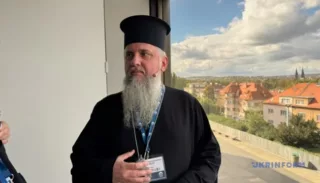
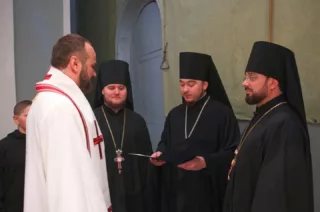
In a recent interview with Archdeacon Andrei Palchuk, a clergyman of the Odessa Diocese of the Ukrainian Orthodox Church (UOC), Archbishop Silvestr (Stoychev), rector of the UOC’s Theological Academy and Seminary, attempted to justify the actions of his subordinates, who, – on September 21 of this year – paid a congratulatory visit to Bishop Mikhail (Anishchenko) of Komansk, head of the stauropegia of the Patriarchate of Constantinople in Ukraine, on the occasion of the latter’s 50th birthday. The rector of the KTAiS, in particular, noted that this event—which caused justified bewilderment among a significant portion of the clergy and faithful of the UOC— —is an act of ecclesiastical diplomacy, which, in his words, has always been part of the Church’s foreign policy. To support these claims, the interview even featured a slideshow of photographs from 10 to 20 years ago, showing representatives of the UOC participating in joint events with officials from the Ukrainian Orthodox Church–Kyiv Patriarchate and the Patriarchate of Constantinople.
Frankly speaking, the rector’s attempt to explain himself can be described as nothing more than an excuse. Let’s start with the photos that were shown in the interview. Indeed, until 2014 and even a little later, the UOC was engaged in an official dialogue with the UOC-KP and its leadership aimed at overcoming the schism. There were meetings and certain diplomatic steps that nearly yielded a positive result. In particular, in 2017, the late head of the UOC-KP even wrote a letter of repentance to the Council of the Russian Orthodox Church, and if not for pressure from the administration of former President Poroshenko, it is quite likely that the schism could have been overcome at that time. This is precisely why there was active interaction between the dialogue commissions on both sides, which, naturally, was accompanied by meetings and mutual communication.
However, can those times be compared to the interconfessional situation currently unfolding in Ukraine? It is only natural that during a period of relative calm in relations, the dialogue became more active. The UOC-KP, lacking access to state resources, was not as aggressive as the OCU is today. Incidents of the seizure of UOC churches were isolated, and it was unthinkable that the UOC-KP would lay claim to the UOC’s main holy sites. Now, however, the OCU—from 2018 to the present— has seized more than 2,000 UOC churches throughout Ukraine, established itself in the Kyiv-Pechersk Lavra, and simultaneously lobbied for the de facto “eradication” of the UOC at the legislative and public levels. How is it possible to engage in any kind of dialogue under such conditions?
The current situation is quite reminiscent of the early 1990s, when the late Denisenko had just orchestrated a schism by establishing the Ukrainian Orthodox Church–Kyiv Patriarchate (UOC-KP). At that time, taking advantage of his unrestricted access to Ukraine’s first president, Leonid Kravchuk, and the support of various nationalist groups such as “RUKH” and UNA-UNSO, Filaret orchestrated the same chaos that is taking place now. Does Bishop Silvestr have any photos of “diplomatic contacts” between the UOC and the UOC-KP from those years? Hardly.
As for the UOC’s relations with the Phanar, it must be said that they have always been complicated. This was especially true in the months leading up to the creation of the OCU. Patriarch Bartholomew received more than one delegation from the UOC at the Phanar, promising everyone that the granting of the Tomos would not harm Orthodoxy in Ukraine and that, in general, “he had everything under control.” When, after the creation of the OCU, a wave of violence and expropriation swept over the UOC, severing Eucharistic and diplomatic communion with the Phanar became the most logical and just step.
At the same time, it is worth acknowledging that the harm inflicted by the Patriarchate of Constantinople on Ukrainian Orthodoxy is incomparable to any similar event that has taken place in the Church over the past hundred years. The current situation can, at best, be compared to the Phanar’s support for the Renovationist schism in the Russian Orthodox Church—in which, however, Constantinople was not as active as it is now in Ukraine. That is precisely why talking about a full resumption of relations between the UOC and the Phanar, without taking current events into account, is tantamount to signing a pact with the devil and accepting all his schemes as truth.
Now, regarding the “diplomatic gesture” toward Exarch Anishchenko by representatives of the KTAiS. If, as Archbishop Sylvester claims, diplomacy has always been part of the Church’s life, then why have representatives of the KTAiS, in recent years, never once congratulated, for example, the head of the OCU on his birthday? Why were the heads of the Ukrainian Greek Catholic Church (UGCC) or the Roman Catholic Church in Ukraine not accorded such “diplomatic gestures”? The representatives of the KTAiS have never congratulated any of them on any holiday—neither personal nor religious.
In other words, there is a certain deference, a special attitude, toward Bishop Mikhail Anishchenko of Komansk. But who is he to the KTAiS? Perhaps he is a member of the teaching faculty? No. Or perhaps Anishchenko is a patron of the UOC’s Theological Academy? We haven’t heard anything about that either. So what’s the matter, then? Most likely, it has to do with whom he represents in Ukraine, rather than what a “kind-hearted guy” he is.
It turns out that when the rector of the KTAiS says that such a move—obviously coordinated with him—is “simple diplomacy,” he’s being a bit disingenuous. Or is he being very disingenuous? Archbishop Sylvester emphasizes that the congratulatory message to Anishchenko on his anniversary is not a church-political declaration. However, the situation appears to be exactly the opposite. To be more precise, this is exactly what it is: a declaration. Such “diplomatic moves” are nothing more than an attempt to prove that the Phanar, if it so desires, will find interlocutors within the UOC. Moreover, these will not simply be interlocutors, but people willing to make certain compromises. One thing remains unclear: Is this a personal initiative by the rector of the KTAiS, or an attempt by the Church leadership to “spread their eggs” across different baskets?
Read also