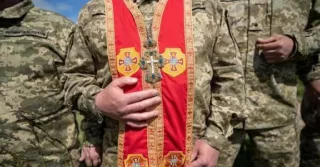
UN report criticizes Ukrainian government's ban on UOC
The United Nations has published the final report of the Office of the United Nations High Commissioner for Human Rights, which points to the non-compliance of the scandalous law No. 3894 aimed at banning the activities of the Ukrainian Orthodox Church. The document states that Ukraine failed to substantiate the need for and proportionality of measures aimed at banning religious organizations. The report was published on the website of the UN Human Rights Office.
It is noted that on September 23, 2024, legislative changes regarding religious organizations came into force. The law under which these changes were introduced refers to “national (or public) security” as a basis for restrictions on freedom of religion or belief and freedom of religious association. However, neither the International Covenant on Civil and Political Rights (ICCPR) nor the European Convention on Human Rights define “national security” as one of the permissible grounds for such restrictions.
From the UN’s perspective, the amendments impose disproportionate restrictions on the freedom to manifest one’s religion or belief.
The amendments introduce significant restrictions, including a ban on the activities of foreign religious organizations based in states responsible for armed aggression against Ukraine, as well as their Ukrainian partners. “If a court finds that a Ukrainian religious organization is affiliated with a banned foreign organization, it may order its dissolution,” the report says.
OHCHR notes that the dissolution of a religious organization is a serious restriction that requires strong justification. “Dissolution affects the ability of individuals to manifest their religion or belief in community with others and threatens the viability of the community as a whole,” the experts note. However, as stated in the document, “Ukraine has not demonstrated the necessity and proportionality of this measure, for example, has not explained why less restrictive approaches, such as measures aimed only at specific individuals, would be insufficient.”
Of particular concern is the vagueness of the wording in the amendments. For example, the law provides for the dissolution of organizations if their “authorized persons” are found guilty of crimes, including threats to national security, or if they are involved in “repeated facts” of spreading “propaganda of the Russian World ideology.” “Such vague wording does not provide a clear understanding of the requirements of the law and may hold entire religious communities responsible for the actions of individuals,” the report notes.
In addition, the document emphasizes that the amendments provide for the cancellation of lease agreements for religious facilities on the basis of an administrative decision before the court. OHCHR draws attention to the fact that this may lead to the loss of access to historic church buildings, which “is particularly problematic for communities with a small number of churches, as it restricts freedom of religion and contributes to social tensions.”
Earlier, we reported that the international human rights organization Human Rights Watch criticized Law No. 3894 (formerly No. 8371), which is aimed at banning the activities of the Ukrainian Orthodox Church. The organization believes that the law banning the UOC grossly violates human rights to freedom of conscience and, according to its provisions, will make it impossible for Ukraine’s largest religious denomination to function. Human Rights Watch called on the Ukrainian government to stop the implementation of Law No. 3894 and send it to the Venice Commission for legal expertise.
Read also