Will Pochaev Lavra become a Ukrainian Esphigmenum
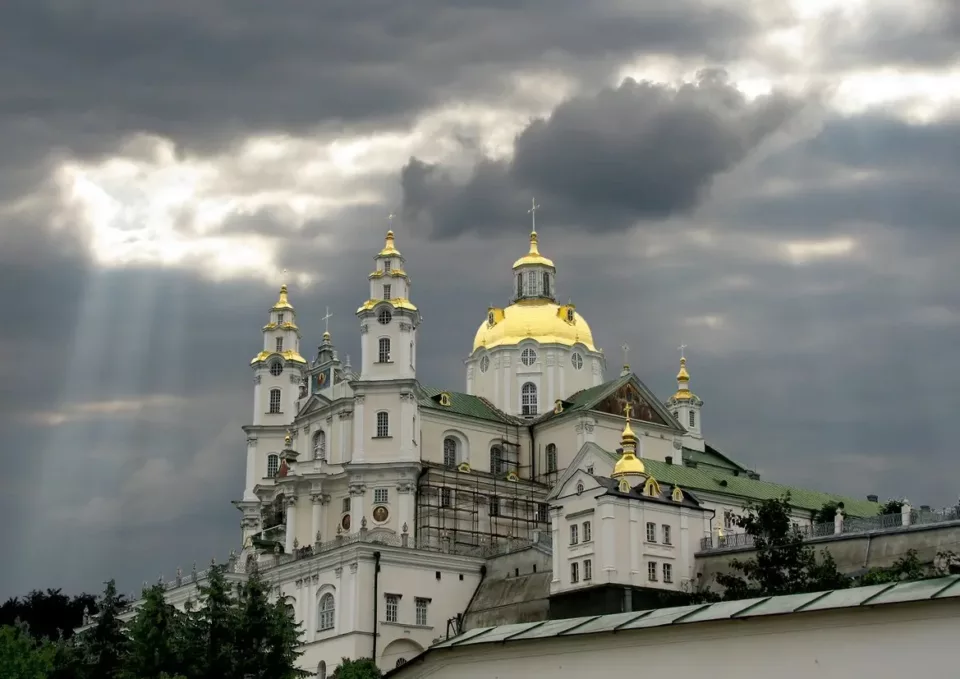
A week before the celebration of the Pochaev Icon of the Mother of God, the Ukrainian Ministry of Culture has finally published the data of the expertise, which a special commission of the MCIP conducted on the territory of Pochaev Lavra during the last month. And although the data of the report, which appeared in the media, are extremely sketchy, but even based on them we can understand that the Holy Dormition Pochaev Lavra is being dragged into the same maelstrom of events that its “sister” in Kiev has experienced.
The commission that conducted the examination established the fact that a number of icons that were on the inventory list back in 1967 were missing! In addition, the MCIP is extremely dissatisfied with the fact that the Lavra has been undergoing “unauthorized” restorations and renovations, which all this time were at the expense of the monastery, not the state. Formally, these facts can indeed serve as a reason to break the agreement on rent-free lease, which was signed between the monastery of the UOC and the state until 2053. Apparently, the MCIP is set up for just such a development of events. But what will happen next? Will the state be able to expel the UOC from Pochaev Lavra?
There are not many good lawyers
Based on the way similar events developed in Kiev-Pechersk Lavra, it is obvious that the next step will be a lawsuit from the Ministry of Culture for early termination of the lease agreement for the premises, which are part of the National Reserve and are now used by the UOC monastery. However, the essential difference between the situation in Kiev-Pechersk Lavra and Holy Assumption Pochaev Lavra is that in Kiev the term of the agreement has expired and it was not renewed, here there will be an attempt to cancel the document, which, of course, is much more difficult.
The whole point is that the monastery may file a counterclaim, in which there may be substantial financial claims against the state, due to the fact that, according to the contract, the monastery still maintained the premises leased to them in proper condition. The notion of “unauthorized restoration” may then take on new colors.
If it was restoration, then why did it take place? Obviously, it was because icons, paintings and other utensils had deteriorated over time, for which, in fact, they had to be restored, i.e. preserved in their original state. Why was the restoration unauthorized? If the state had a proper attitude to the preservation of architectural monuments, then it would allocate funds from the budget, such work would be carried out regularly and without regard to the denomination to which this or that religious building was given for use. But what is it always like with us? Ukrainian Catholics have their churches repaired and restored by Poles. The OCU very often creates a burden on local budgets. If the owner of the temple/architectural monument is the Ukrainian Orthodox Church, then “solve your problems on your own”. There are no funds, or all the specialists are busy.
Moreover, if it came to the point that something needed to be restored, getting permission for this work from the state turned the situation into a theater of the absurd. The state, which, for one reason or another, refused to allow UOC congregations to restore certain objects, did not give permission for this work to be carried out by non-state experts. Moreover, if the tenant had the money to carry out such work, the Ministry of Culture immediately found experts, who, however, charged several times the price for the work, and the process dragged on for years.
Thus, for the UOC, as the largest tenant of all religious communities, conditions were created in which, if you do not restore, you violate the terms of the contract, as it was in Chernihiv with the Transfiguration Cathedral and Eletsky Monastery. And if you restore – even at your own expense, but with the involvement of non-state experts – it is still a violation of the terms of the contract, as it happened in Pochaev.
But, in such a situation, a number of questions arise. First, what is better – not to restore at all or to do something to preserve the architectural monument, but without looking at the state bureaucracy? At the same time, if something in Pochaev has been restored, being “state property”, then why did the Ministry of Culture not control all this earlier, and only now became interested in it? Please note that the commission itself checked the presence of certain historical values according to the inventory list from 1967! To put it simply, for 57 years the data on historical values have not been significantly updated, and the Ministry of Culture did not care about what was going on in Pochaev Lavra.
These and many other questions can, in the event of a trial, be put to the responsible officials of the Ministry by good lawyers, of whom Pochaev Lavra must now have many. In addition, the counterclaim could well include an invoice for the expenses incurred by the monastery during its stay within the walls of Lavra. Considering the decades of the most difficult work to preserve and maintain the Lavra in proper condition, the sums involved would be astronomical.
Pochaev has prepared
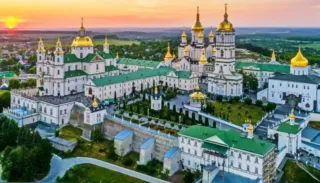
And so, if the monastery will be evicted from the Lavra, will the monks have to leave the entire territory or do they still have options? The peculiarity of the Pochaev Lavra structure is that it is a relatively compact area, which houses 10 churches, 2 large hotel buildings and cells with the household part, which, of course, is taken out of the territory of the monastery. As of today, the Lavra has more than 200 brethren with almost the same number of laborers who live at the monastery.
Of these ten temples, only one – the Transfiguration of the Savior, which is the largest in the monastery – does not belong to the monuments of architecture. It was built relatively recently and on completely legal grounds. Also – a new hotel building, which is practically adjacent to the Transfiguration Cathedral. Thus, these two buildings as of now do not belong to the state, and the Ministry of Culture has no claims to their construction.
If even purely theoretically it happens that the state manages to take away a large part of Lavra from the monastery, the situation will not become as critical as in Kiev. The Transfiguration Cathedral will be used for its intended purpose, as a cathedral, and the hotel building will become a fraternal building, where, in fact, the monks will move, in case of their eviction from the premises, which are monuments of architecture and are used under the contract with the Ministry of Culture. In addition, as the capital’s practice has shown, monks may not leave the premises they occupy, as they are officially registered in them, and mechanisms of forced eviction of monks have not yet been introduced, apparently fearing scandals around such situations.
In general, those who are familiar with the mentality of Pochaev residents have long known that the Lavra has always been ready for such upheavals. For a long time the Lavra clergy warned the brethren and parishioners about the coming events, urging the faithful to leave the city and settle in Pochaev. Thus, the population of the town today is mostly Orthodox and ready, if necessary, even to house the monks. So, we should not ignore the fact that Pochaev is in favor of the UOC in Lavra. Whether the believers will defend the monastery or repeat the Kiev situation is an open question.
Again, since Pochaev Lavra is a very compact place, with only two entrances to the territory, nothing will prevent the monastery from turning into a Ukrainian Esphigmen, if it has the blessing of the vicar. Those who have been to Lavra can be convinced that, with the gates closed, the monastery becomes virtually impregnable. However, whether it will come to a siege – it is difficult to say.
Factor 8371
Separately, it should be noted that the events around Pochaev Lavra may unfold in an extremely unpredictable way, if the law № 8371, aimed at banning the UOC, will be adopted. In this case, the state will not even have to prove anything in courts. Architectural monuments will be seized from the property of the UOC by definition and without additional piety. By the way, if the law cannot be passed at the end of August, it is possible that the situation with the expropriation of Pochaev Lavra will be a consolation prize for those who are “beating their hooves” in the hope of ending the UOC.
Be that as it may, the brethren of the monastery already now need to think over the options of how Lavra will respond to the approaching crisis. At least outwardly, everything looks like only the intervention of the Heavenly Abbess of the monastery will be able to resolve the situation in a way that is acceptable to the monastery.
Read also